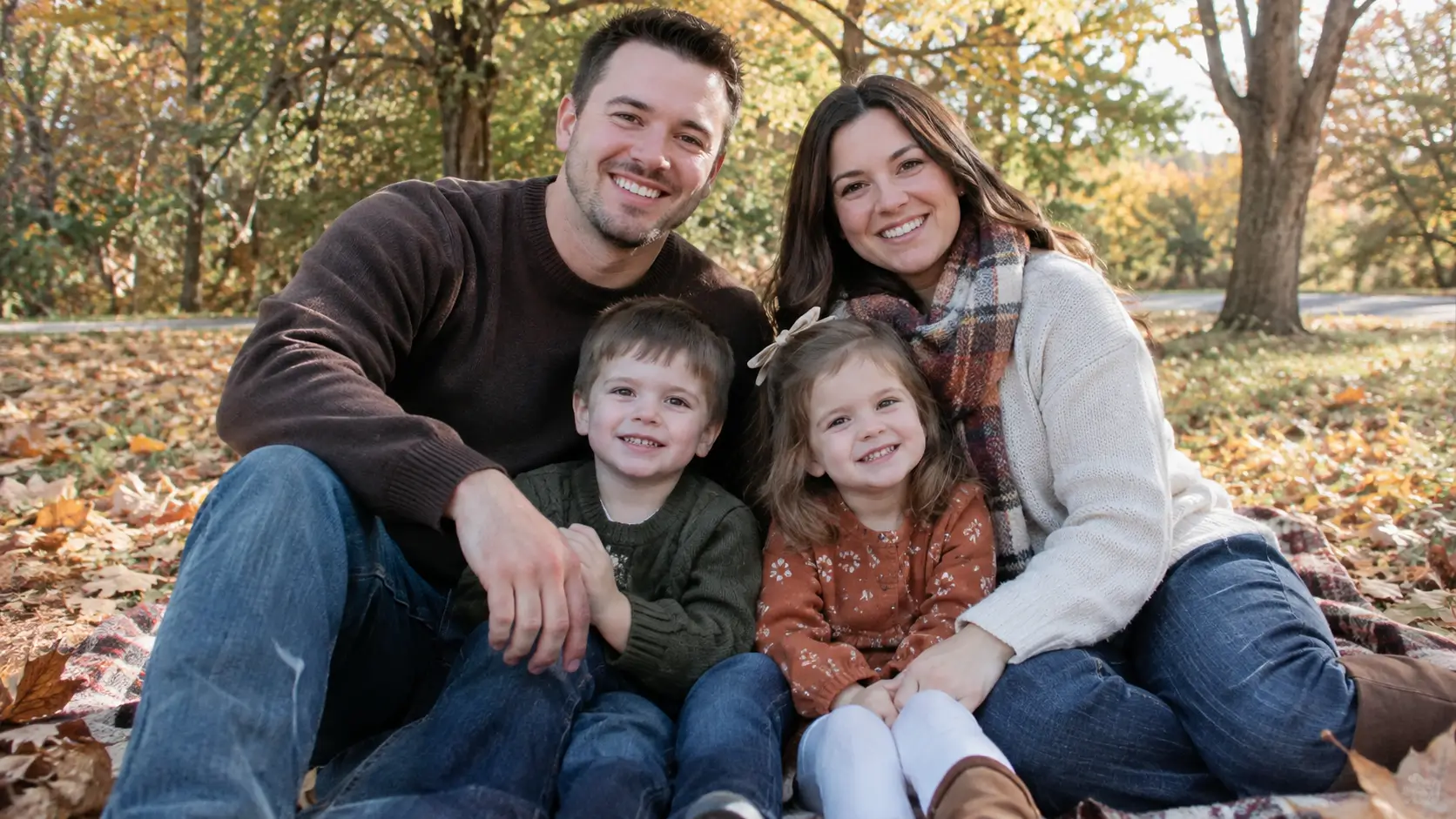
A family picture session usually has one hour, one location, and anywhere from three to fifteen people who need to agree on what they’re wearing before anyone leaves the house. That’s the real problem fall family photos solve for — not finding the one perfect sweater, but getting that many closets pointed in the same direction without anyone feeling like they’re in a costume.
This list skips past the single rust-colored sweater everyone already owns and goes further: outfits built around what a specific family actually has, from a newborn who needs nothing more than a cream knit to a teenager who negotiated hard for “just a flannel, nothing matchy.” Some ideas cost nothing beyond what’s already hanging in the closet. Others lean on one new piece to pull a whole group together.
Twenty-seven options follow, grouped by the kind of family or budget they solve for rather than by color alone, because the outfit that works for a family of four in a studio doesn’t always work for nine people standing in a pumpkin patch.
The Familiar Palette, Worn With One New Idea
Rust, mustard, burgundy, and olive show up in almost every fall photo gallery for a reason — they photograph well against bare trees and hay bales. These four lean on that same palette but change how the pieces come together.
1. Rust Cardigan Over a Cream Dress
A rust-colored cardigan, buttoned all the way up, worn over a plain cream slip dress or simple cotton dress underneath. The cardigan does the color work; the dress underneath stays quiet enough that it would look right under three other sweaters too.
Buttoning the cardigan closed instead of leaving it open changes the silhouette from a sweater thrown on to an actual outfit, and it reads as one solid block of color in photos instead of two competing layers. It also means whoever’s wearing it can take it off the second the sun comes out without losing the dress underneath as a backup look.
For a petite frame, a cardigan that hits mid-thigh lengthens the leg line better than one that stops at the hip. For anyone running warm, a three-quarter sleeve version solves the same problem without the full long sleeve.
2. Mustard Turtleneck Under a Chocolate-Brown Jumper
A thin mustard turtleneck worn underneath a sleeveless chocolate-brown jumper or pinafore, the kind usually paired with a white blouse in spring. Swapping the white for mustard turns a spring piece into a fall one without buying anything new for the jumper itself.
The dark brown grounds the brighter color so it doesn’t compete with everyone else’s rust and olive, and the turtleneck means the outfit still works once the temperature drops ten degrees between the call time and the actual shoot.
3. All-Burgundy Family, Head to Toe
Every person in one shade of burgundy — a wine sweater on one adult, a maroon flannel on another, a deep red cardigan on a child — rather than everyone matching the exact same item. The color repeats; the pieces don’t.
One color head to toe across a group photographs as deliberate instead of coordinated to death, and it’s the easiest option on this list to pull off with clothes already in the closet, since burgundy shows up somewhere in most fall wardrobes already.
4. Olive Corduroy for the Whole Crew
Olive green corduroy — a jacket on one parent, pants on a sibling, a skirt on another — mixed with plain cream or white tops so the texture of the corduroy becomes the visual interest instead of a pattern.
Corduroy has enough texture to read as dressed-for-fall even in a plain olive without needing a pattern on top of it, and it holds up better than smooth cotton if anyone’s sitting on grass, hay, or a wooden bench for twenty minutes.
Low-Lift, High-Impact Thrift Finds
None of these four need a shopping trip. They’re built around what’s already in a closet, a hand-me-down box, or a thrift store rack, with one new piece doing the work of pulling the rest together.
5. Secondhand Flannel in Mismatched Plaids
A different plaid flannel on every person — a red-and-black buffalo check on one, a smaller blue-and-green tartan on another — instead of the usual approach of putting everyone in the same pattern.
Plaids in the same general color family read as a set even when the pattern itself doesn’t match, the same way a gallery wall works with different frame styles as long as the finish is consistent. It also means five flannels can come from five different closets, or a single thrift store bin, without anyone needing to find four more of the same shirt.
Keep the scale varied — one large check, one small check, one plain shirt in a matching color — so the mismatch reads as intentional rather than like nobody checked what everyone grabbed.
6. One Shared Thrifted Barn Coat
A single oversized barn coat or canvas chore jacket, thrifted or borrowed, that gets passed around and worn open over whatever everyone’s already wearing underneath — draped over shoulders in some shots, buttoned up in others.
It’s one purchase instead of several, it gives the group a prop to hand off between shots, and because it’s worn open rather than zipped, it doesn’t need to fit any particular body in the family, just drape.
7. Hand-Me-Down Sweaters With New Scarves
The sweaters already sitting in a hand-me-down bin — slightly mismatched, different brands, different ages — paired with a few new scarves in one shared color to tie them together.
The scarf is the cheapest single item on this list that can unify a whole group, and because it sits at the neck, it reads first in a photo even when the sweaters underneath don’t match each other at all.
8. Old Jeans, One New Top Color
Whatever denim is already in rotation — different washes, different cuts — worn with one new top color repeated across the group: a rust top here, a mustard one there, nothing else purchased.
This is the lowest-cost option on the list because the jeans never have to match each other, only the washes need to be reasonably close in tone, and the new tops can be as simple as a single basic layering piece bought in bulk.
Big Families and Blended Crews
Past five or six people, matching stops working and sorting starts. These four are built for families where coordinating everyone in the same item isn’t realistic.
9. Denim Bottoms, One Shared Sweater Color
Every person in their own jeans, and every person in a sweater that falls somewhere in the same one or two colors — rust, cream, or a mix of both — regardless of the sweater’s exact style or brand.
This is the formula most large families land on because it needs the least agreement: denim is already standard, and “pick a sweater that’s rust or cream” is an instruction a nine-year-old can actually follow without a fitting.
For a family spanning several sizes, buy the sweater color in whatever’s available at different stores rather than hunting for the same brand in every size. The color match carries the look, not the cut.
10. Step-Siblings in Matching Beanies
Kids from two different households, dressed in whatever they’d normally wear, unified by one shared accessory — the same beanie color, or the same brand of boot — rather than a fully coordinated outfit.
For a newly blended family, forcing identical outfits can feel like erasing who came from where. One small shared item signals that the family is a unit without asking anyone to give up their own style, which matters more to a ten-year-old than it sounds.
11. A Big Family Sorted by Shade
Everyone wearing a different kind of piece — a dress, a flannel, a sweater, a jacket — but every piece pulled from the same narrow range of tan, rust, and cream, so no two outfits repeat but nothing clashes either.
Sorting by shade instead of by item is the only strategy that scales past about six people, because it only asks one question per person — does this fall somewhere between tan and rust — instead of needing nine versions of the same sweater in nine different sizes.
Lay every planned outfit out on a bed or floor the night before and look at them as a group. A piece that reads as rust on its own sometimes reads as pink or orange next to the others, and that’s easier to catch on a bed than in front of a camera.
12. The Blended-Family Flannel Swap
One parent’s old flannel shirt re-worn as an oversized layer by a teenager, a cardigan handed down from an older sibling to a younger one — pieces that already moved between family members before the photo was ever planned.
Clothes that have already been passed around a blended family carry a kind of history a newly bought matching set doesn’t, and in a candid shot — someone adjusting a sibling’s collar, a sleeve rolled up that’s clearly too long — that history reads as warmth rather than as mismatched.
Babies, Toddlers, and the Ages In Between
A six-month-old, a stubborn four-year-old, and a teenager who’d rather not be there all need different handling. These four work with each age instead of around it.
13. Neutral Newborn, Colorful Siblings
The baby in a plain cream or oatmeal knit swaddle or bodysuit, nothing patterned, nothing bright, while older siblings take on the rust, mustard, and burgundy the rest of the family is wearing.
A newborn this young doesn’t register as left out by wearing something plainer. Keeping the baby neutral actually makes the baby the visual anchor of the photo, since every busier color in the frame leads the eye back to the one calm spot.
14. Toddler Overalls Over a Flannel
A toddler in corduroy overalls — tan or rust — layered over a secondhand flannel shirt in any pattern, sleeves rolled to fit, rather than a toddler-sized version of what the parents are wearing.
Overalls solve the two real toddler problems at once: they survive sitting in dirt or hay without anything riding up, and the thrifted flannel underneath doesn’t have to fit well or match anything else in the family, since the overalls cover most of it anyway.
Buy the overalls a size up. A toddler who can bend, climb, and sit without the straps pulling will last through the whole session, where a snug pair gets fought off within ten minutes.
15. A Flannel Over Their Own T-Shirt
Whatever graphic T-shirt or hoodie a tween already wears daily, left exactly as is, with a single open flannel layered over the top in a color that matches the rest of the family.
This is the compromise that actually gets a reluctant tween into the photo at all. They keep their own shirt, their own style stays visible when the flannel’s pushed open, and the family still gets its coordinated color without a fight over what’s underneath.
16. A Hand-Knit Cardigan, Passed Down
A cardigan or sweater that’s already been worn by two or three older cousins or siblings, put on the youngest member of the family exactly as it is — a little worn at the cuffs, maybe missing a button.
A piece that’s visibly been through a few kids photographs with a softness a brand-new sweater doesn’t have yet, and it’s a detail that means something to whoever’s looking at the photo years later, even if nobody else notices it.
Fabric and Texture Over Pattern
A plaid print is one way to add interest. Texture is another, and it photographs just as well without the risk of five different plaids fighting each other in frame.
17. Cable-Knit Sweaters, No Two Alike
A cable-knit sweater on every person, each one a different style — a fisherman knit, a turtleneck cable, a cardigan version — but all in neutral tones like oatmeal, grey, or camel.
The texture itself becomes the pattern, so no two sweaters have to actually match, only the color family does, and cable knit holds its shape through an hour outside better than a thinner sweater that goes limp the moment it’s slightly damp.
If the group spans a wide range of ages, let the kids wear thinner cable-knit cardigans instead of the bulky pullovers the adults have on. A toddler in a full fisherman sweater overheats fast once the photos move into direct sun.
18. Corduroy Head to Toe
Corduroy pants, a corduroy jacket, and a corduroy skirt, all in the same camel or rust tone, worn by different people in the group rather than one person wearing all three pieces.
Corduroy’s ridges catch light differently depending on the angle, which gives a monochrome outfit enough visual texture to avoid looking flat in photos, something a single-color outfit in smooth cotton usually can’t manage.
19. Velvet for Adults, Flannel for Kids
A velvet blazer or dress on the adults, paired with plain flannel shirts on the kids — two different fabrics doing two different jobs instead of everyone matching material.
Velvet reads as more formal and flannel reads as more casual, so splitting them by generation solves a real styling problem: it lets the parents dress up a notch without putting the kids in anything stiff enough to make them miserable by the second location.
20. Waffle-Knit Henleys Under Open Flannel
A waffle-knit henley in cream or rust worn underneath an open, unbuttoned flannel shirt — on an adult or an older kid — so both textures show at once instead of one hiding the other.
The waffle texture at the neck and cuffs adds detail close to the face, which matters more than people expect, since most of a family photo’s visual interest ends up concentrated around everyone’s faces and necklines anyway.
Dressed for Where You’re Shooting
An outfit built for a studio backdrop doesn’t always survive a pumpkin patch, and a hiking-trail outfit looks out of place on a city rooftop. These four are built around the location first.
21. Denim Jacket Over a Sunday Dress
A denim jacket thrown over a simple floral or solid Sunday dress, worn with boots instead of flats, built for standing between trees and climbing in and out of a wagon.
The jacket does double duty as both a styling layer and actual protection from the scratchy branches and wooden crates that show up at most orchards, and it comes off easily for a few shots without changing the dress underneath.
Pick a jacket a shade darker than the dress so it reads as an intentional layer rather than something grabbed at the last minute because it was cold.
22. Backyard-Bonfire Outfits That Survive S’mores
Darker, more forgiving colors — charcoal, deep rust, olive — chosen specifically for a backyard session that involves a fire pit, marshmallows, and kids sitting directly on the ground.
A stain that would ruin a pale cream outfit barely registers on charcoal or deep olive, which matters more for a backyard shoot than a studio one, since nobody’s changing clothes between the posed shots and the actual s’mores.
23. Rooftop Looks in Camel and Black
Tailored camel coats over simple black or charcoal pieces underneath, built for a concrete rooftop or city street backdrop rather than a rural one — no plaid, no florals, nothing that reads as farm against a skyline.
Camel and black photograph cleanly against concrete, glass, and skyline in a way busier fall colors can wash out or compete with, and the tailored shape of a coat holds up better in wind than a loose cardigan does fifteen stories up.
A knee-length coat works for most body types in this combination. A longer coat can overwhelm a shorter frame against a backdrop that’s already mostly straight lines.
24. Hiking Fleece With One Scarf
Whatever fleece jackets and hiking pants the family already owns for an actual trail, left as is, with one plaid or solid scarf added to each person to pull the look toward “fall photo” instead of trail maintenance.
This works specifically because it doesn’t fight the setting. A hiking trail photographed in flannel and boots looks staged, while technical gear with one small styling addition looks like the family that was actually going to hike anyway.
For the Family That Refuses to Match
Some families have a hard no on coordinated outfits, and the last three ideas work entirely around that, down to the family dog.
25. One Color, Worn However Everyone Wants
A single agreed-on color — rust, say — with zero rules about which piece carries it: a scarf on one person, a full sweater on another, just a pair of socks on a stubborn teenager who showed up in black.
This is the loosest version of coordinating that still photographs as a group, because the eye catches the repeated color across the frame even when every single garment is otherwise unrelated.
26. Grandparents Told Just “Warm Neutrals”
Grandparents dressed in whatever they already own that falls under tan, cream, grey, or brown, with no further direction given beyond that one phrase.
Asking an older family member to buy something new for one photo session is a harder ask than it looks, and most closets already have enough warm neutrals in them that the instruction costs nothing and still lands as coordinated.
If a grandparent asks for more specific direction, naming one item — a cardigan, a button-down — rather than a whole outfit tends to get a better result than an open-ended color note alone.
27. The Family Dog in Plaid
The family dog in a simple plaid bandana or bowtie collar, while every person in the family wears whatever they’d pick for themselves with no coordination at all.
Putting the single coordinated element on the dog gives the photo one visual anchor without asking a single person to compromise on their own outfit, and it tends to be the detail people notice first anyway.
Final Thoughts
The strongest fall family photos usually come from whichever of these a family would still be wearing an hour after the session ends — nobody tugging at a collar, nobody too warm in a coat they only put on for the camera. Picking the one idea that fits the actual people in the photo, rather than the most popular palette of the year, is what makes the picture worth keeping out.