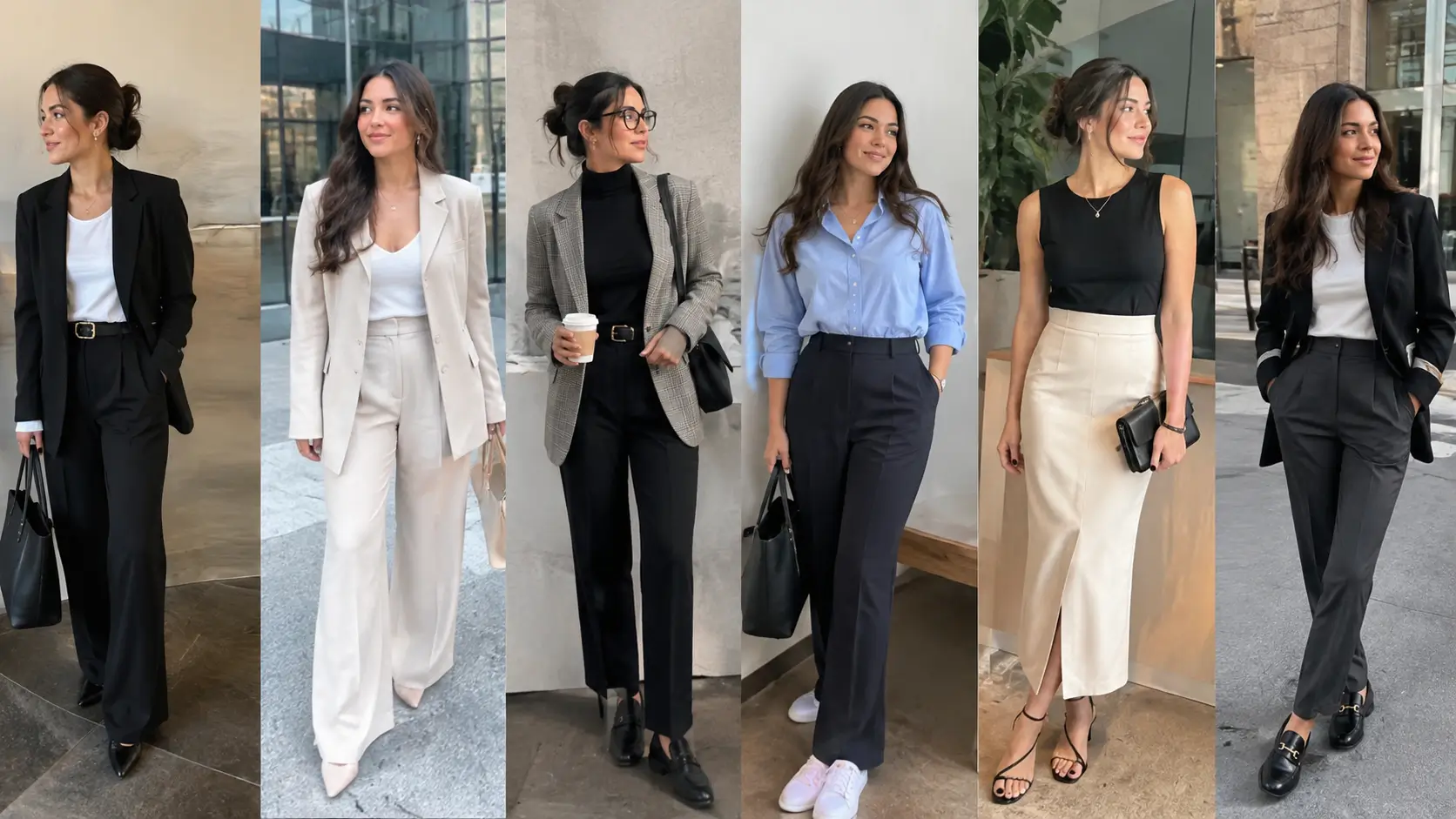
A headshot outfit does one job: it has to read clearly in a square crop, at thumbnail size, for the next few years. That’s a different brief than a going-out look or a vacation photo, and most of the mistakes come from forgetting it — a print that moirés on screen, a neckline that gets lost against the backdrop, a color that pulls the eye away from the face instead of toward it.
None of the ideas below need a stylist or a trip to a department store. Most pull from pieces already in a closet, recombined with the backdrop, the industry, and the camera’s habits in mind rather than general fashion rules.
The list runs from boardroom-formal to the kind of soft layering a creative team actually wears, with notes on color, fit, and the small details that read differently once a photo gets cropped to the shoulders.
Blazer-First Looks
A blazer is the fastest way to signal “this is a work photo” without looking like a uniform. These four treat it as the main event rather than a layer to forget about.
1. Boxy Cream Blazer Over a Black Tank
An ivory or cream blazer worn open over a plain black tank puts light fabric right at the face, which does more for a tired complexion than concealer does. The boxiness matters here — a fitted blazer in a pale color can look like a uniform, while a boxier cut reads as a deliberate choice.
Cream also sidesteps the glare that bright white throws under studio lights, so skip white for this particular combination and let the tank underneath carry the contrast instead. It photographs well against both a light grey backdrop and a muted navy one.
2. Double-Breasted Navy Blazer, Nothing Underneath But a Cami
A double-breasted navy blazer buttoned over a thin cami, rather than a blouse, keeps the neckline simple enough to survive a tight crop. The extra row of buttons gives the jacket enough visual weight that it doesn’t need a shirt collar competing underneath.
Navy holds its color better than black under most studio lighting setups, which is part of why it shows up across almost every headshot guide, but the double-breasted cut is what keeps this version from looking like the default option.
If the cami shows at all in the final crop, keep it a shade darker than the skin tone rather than matching it exactly — an exact match tends to read as bare in a photo, even when it looks fine in person.
3. Blazer With a Fine-Knit Top and Tailored Trousers
A blazer over a fine-gauge knit top, paired with tailored trousers, is close to the default professional headshot outfit for a reason — it reads as competent in almost any industry and photographs cleanly from the waist up.
The knit top is doing more work than it gets credit for: it softens the blazer’s structure just enough that the whole look doesn’t feel like a courtroom appearance, and it gives the camera some texture to pick up where a flat blouse wouldn’t.
4. Oversized Charcoal Blazer With Gold Button Detail
An oversized charcoal blazer with visible gold buttons down the front adds one point of interest without adding a pattern. The scale of the blazer matters more than the hardware itself — oversized here means past the shoulder seam, not sloppy.
Charcoal reads slightly softer than black on camera and holds detail in the fabric better, so the gold buttons actually catch light instead of disappearing the way they might against true black.
This one leans toward finance, law, and real estate headshots specifically — industries where a bit of polish is expected but a plain blazer can look interchangeable across a hundred other profile photos.
One-and-Done Dresses
A single piece removes half the decisions — no matching separates, no wondering what shows below the frame. These four carry a headshot on their own.
5. Jewel-Tone Wrap Dress in Emerald
A wrap dress in a jewel tone like emerald is one of the most recommended headshot outfits for a reason: the wrap neckline is flattering in a cropped photo on almost anyone, and emerald suits a wider range of skin tones than most single colors manage.
It also solves the pattern problem without looking plain — the color itself is the interesting part, so there’s no print to worry about moiréing under studio lights.
6. Mockneck Sweater Dress in Dusty Plum
A mockneck sweater dress in a muted plum keeps the neckline simple, and the color has enough depth to avoid looking washed out next to a grey or beige backdrop.
Mockneck specifically, rather than a full turtleneck, leaves a little more skin visible at the collarbone, which keeps the look from feeling too buttoned-up for anyone outside a strictly formal office.
7. Structured Shirtdress Belted at the Waist
A structured shirtdress, belted at the waist, reads as more considered than a plain dress because the belt creates a defined shape even in a photo that only shows from the chest up — the camera picks up the cinched line at the waist and the eye fills in the rest.
A shirtdress also has a collar, which gives a headshot a bit more structure around the face than a round or V-neck without requiring an actual blazer on top.
Choose a belt that’s a tone or two darker than the dress rather than a contrasting color — the goal is a defined waist, not a second focal point competing with the face.
8. A Simple Sheath Dress in Camel With a Thin Gold Necklace
A sheath dress in camel is one of the few neutrals warm enough to work for most undertones, and it reads as polished without being as expected as navy or black.
The thin gold necklace earns its place here specifically because camel has almost no contrast on its own — a single small piece of jewelry gives the eye somewhere to land that isn’t just the collarbone.
Color Strategy: Matching the Outfit to the Backdrop
The backdrop a studio uses changes what a color does on camera more than most people expect. These four pair a specific garment with a specific backdrop or undertone instead of guessing.
9. Charcoal Turtleneck Against a Light Grey Backdrop
Pairing a charcoal turtleneck with a lighter grey backdrop creates separation between the subject and the background without needing a strong color at all — the contrast comes from value, not hue.
This combination works especially well for headshots that will end up in black-and-white at some point, like a printed program or a byline photo, since the value contrast holds up even without color.
10. Soft Lavender Blouse for a Fair, Cool Undertone
A soft lavender blouse flatters a fair, cool undertone the way most pastels don’t — it adds color without competing with pink-toned skin, which is the usual problem with pastel pinks or peaches on a cool complexion.
It’s a quieter choice than the jewel tones recommended everywhere else on this list, which makes it useful for a field, like academia or nonprofit work, where a bold color might read as slightly too styled.
11. Deep Berry Top Against a Warm Beige Wall
A deep berry top against a warm beige backdrop uses a complementary pairing instead of the usual contrast rule — the warmth in the beige picks up the red undertone in the berry instead of fighting it.
Berry also tends to photograph a shade cooler than it looks in person under fluorescent studio lighting, so a backdrop with some warmth in it corrects for that rather than leaving the color looking flat.
This pairing works best with a simple round or boat neckline — berry is already doing the visual work, so an interesting collar on top of it starts to look busy.
12. Ivory Knit Top to Break Up an All-Dark Office Backdrop
When a headshot is shot against a dark backdrop — a company’s branded navy or black wall, for instance — an ivory knit top keeps the subject from blending into it, which is a more common problem than people expect once the photo is cropped tight.
Ivory specifically, rather than true white, avoids the glare and slight blue cast that bright white can pick up under LED studio lighting, while still giving enough contrast to stand out from a dark wall.
Soft Layers for Less Formal Industries
Not every headshot needs a blazer. Creative teams, startups, and hybrid offices tend to read knitwear and shackets as the more honest version of “professional” for that workplace.
13. Cardigan Over a Fitted Tank With Straight-Leg Jeans
A cardigan over a fitted tank, worn with straight-leg jeans instead of trousers, is the standard answer for a startup or creative-agency headshot where a blazer would look out of place.
The jeans won’t show in a cropped shot, but the cardigan and tank combination reads relaxed in exactly the way the industry expects, without looking like the subject forgot to dress for the photo.
14. Chunky Knit Sweater With a Collar Poking Out Underneath
A chunky knit sweater with a plain collared shirt underneath, just visible at the neck, takes the casualness of a sweater and gives it one structured detail that keeps it from reading as too relaxed for a work profile photo.
The collar does almost all the work here — it only needs to show an inch or two above the sweater’s neckline to register as intentional rather than like a shirt worn by accident underneath something heavier.
This works particularly well for industries where the audience is a mix of clients and colleagues — teaching, publishing, nonprofit leadership — where neither a blazer nor a plain T-shirt quite fits the expectation.
15. Textured Shacket Left Open Over a Plain Tee
A textured shacket — something with a visible weave or a subtle plaid, left unbuttoned over a plain tee — gives a headshot some dimension without resorting to an actual pattern that risks moiréing on camera.
It reads as more put-together than a plain tee alone but stops well short of a blazer, which makes it a reasonable middle option for a LinkedIn photo in a field that doesn’t quite have a dress code.
16. Fine-Gauge Turtleneck Tucked Into High-Waisted Trousers
A fine-gauge turtleneck, tucked into high-waisted trousers, creates a clean vertical line that still registers in a cropped shot through the way the fabric sits at the collarbone — the tuck itself won’t be visible, but the proportion it creates is.
Fine-gauge matters more than the color here: a chunky turtleneck adds bulk right at the neck and jaw, which is the one place a headshot can’t afford it, while a fine knit keeps the same silhouette without the added width.
This pairs well with a simple middle part and minimal jewelry, since the turtleneck already closes off the neckline completely and doesn’t leave room for a necklace to do anything but disappear underneath it.
Suiting and Structure
For industries where a full suit is still the expectation, there’s more room to vary the shape than the standard jacket-and-trousers combination suggests.
17. Matching Set in Soft Grey Wool
A matching set in a soft grey wool — jacket and trousers, or jacket and skirt — is the safest option on this entire list, and it earns that reputation by photographing consistently well regardless of backdrop or lighting setup.
Soft grey specifically, rather than charcoal or black, keeps the look from reading as severe, which matters more in a headshot than in an interview, since a headshot has no body language or tone of voice to soften it.
18. Single-Button Blazer With a Pencil Skirt
A single-button blazer, left closed rather than open, paired with a pencil skirt gives a more streamlined line than a double-breasted cut or an open blazer over a blouse — most of that line won’t show in a headshot crop, but the single clean closure at the front does.
Closing the single button also means there’s no gap at the chest to manage, which removes one of the more common distractions in a seated headshot, where a blazer tends to fall open slightly.
This combination reads as more buttoned-up than a blazer-and-trousers pairing, which makes it a better fit for law, finance, or government roles than for most creative or hybrid workplaces.
19. Vest and Trouser Set Instead of a Jacket
A tailored vest, worn over a blouse or fine knit with matching trousers, gives the structure of a suit without the bulk of a jacket across the shoulders — useful specifically for a seated headshot, where a jacket can bunch up at the collar in a way a vest doesn’t.
It also reads as slightly less conventional than a full suit without looking underdressed, which makes it a reasonable option for someone who wants to look put-together without wearing what everyone else in the office wears for their photo.
20. Cropped Blazer Over a Midi Skirt for a Petite Frame
A cropped blazer, ending at or just above the natural waist, keeps the proportions right for a petite frame in a way a standard-length blazer doesn’t — a longer jacket can visually shorten the torso even in a photo that only shows from the chest up, because of where the lapels sit.
Paired with a midi skirt that won’t even appear in the frame, the cropped length is really about where the lapel and shoulder seam land relative to the collarbone, which is the part of the outfit doing the most visible work.
A boxier, standard-length blazer isn’t wrong on a smaller frame, but a cropped one tends to photograph as more deliberate rather than borrowed from someone else’s closet.
Texture and Detail Instead of Pattern
Patterns are risky under studio lighting — texture isn’t. These three use surface interest instead of print to keep an outfit from looking flat.
21. Boucle Jacket With a Plain Crew-Neck Underneath
A boucle jacket has enough built-in texture that it reads as interesting under studio lighting without the risk a printed pattern carries, since the texture doesn’t create the fine repeating lines that cause moiré on camera.
Keeping a plain crew-neck underneath, rather than another textured or patterned piece, keeps the jacket as the one point of visual interest instead of competing with itself.
22. Ribbed Knit Top With a Statement Collar Instead of Jewelry
A ribbed knit top with an exaggerated or structured collar — built into the top itself rather than a separate collar piece — gives a headshot a focal point near the face without needing a necklace or earrings to do that job.
This works especially well for anyone who finds jewelry distracting on camera or whose workplace has a policy against visible accessories, since the collar itself is the design detail rather than an add-on.
Ribbing also photographs with more texture than a flat knit, which keeps the top from looking plain even though the color palette stays simple.
23. Classic Button-Down in a Fine Stripe
A classic button-down in a fine pinstripe sits right at the edge of what’s safe, pattern-wise, for a headshot — fine enough that it won’t create a moiré effect on camera, but still more interesting than a solid color.
Worn alone or under a blazer, it’s the most traditional option on this list, and it stays a reliable choice specifically for industries — banking, consulting, government — where traditional is the actual goal rather than a fallback.
Final Thoughts
The constant across all of these is how differently fabric and color behave once they’re reduced to a small, static, often slightly compressed image. An outfit that looks completely ordinary in a mirror can either disappear into a backdrop or dominate a photo in a way nothing in person would have predicted, so it’s worth testing the actual outfit against the actual backdrop — or at least something close to it — before the day of the shoot rather than after.
A steamer the morning of matters more than most of the styling choices above; a wrinkle that’s invisible across a room becomes obvious in a close, well-lit crop.