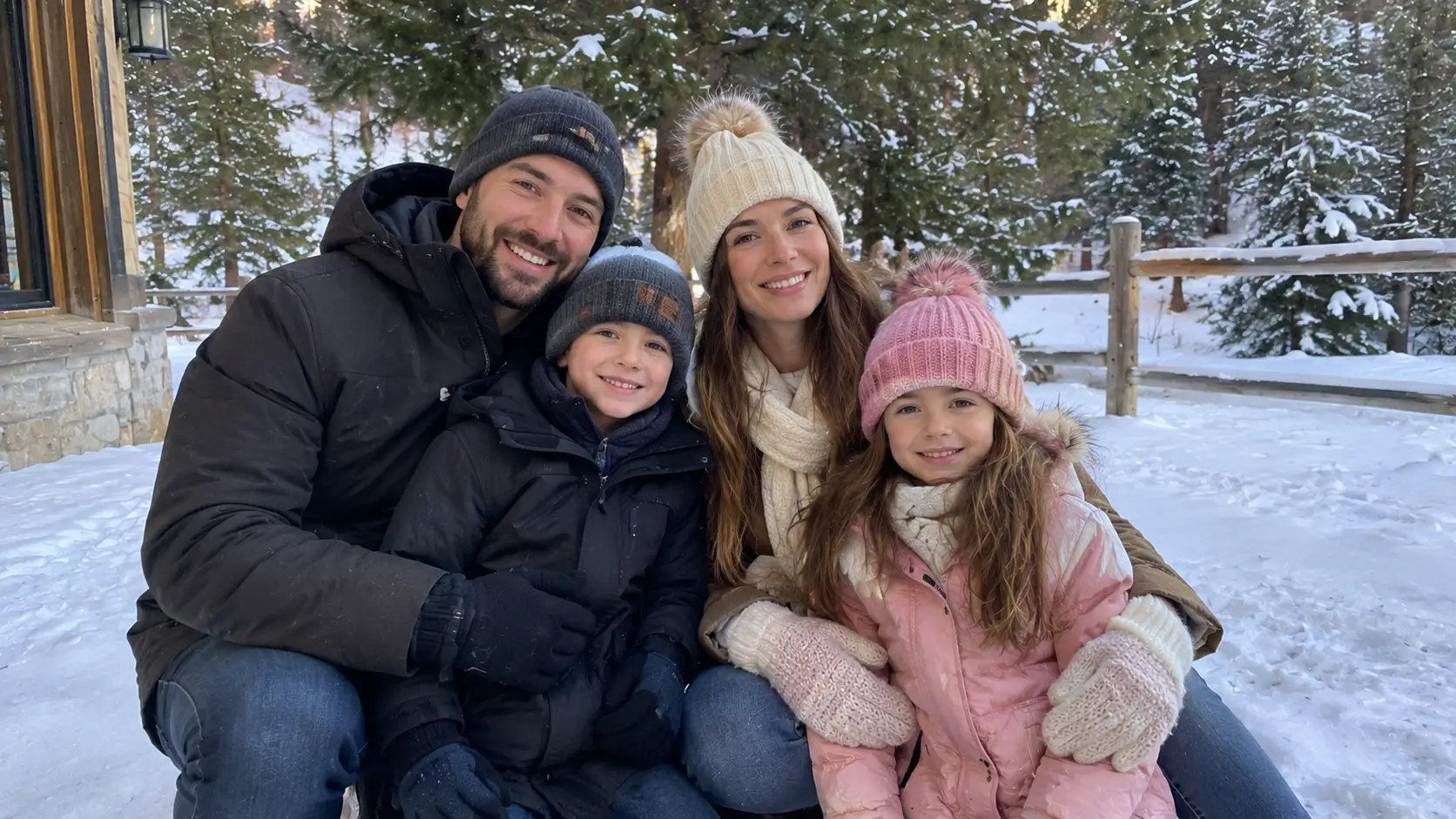
Every family photographer has a horror story about outfits — the one family that showed up in five different shades of red, or the toddler who refused the matching sweater five minutes before the shoot. Winter sessions make this harder, because coats and layers hide half of what people are wearing underneath.
The outfits that actually work in winter photos share a few things: they coordinate without matching exactly, they layer in a way that still reads as one family in the final crop, and they hold up whether someone is carrying a toddler, freezing on a porch step, or sitting still by a fireplace.
Nineteen options below, from a secondhand coat run to a full cabin-weekend production, grouped by what actually drives the decision: the knitwear everyone already owns, the patterns, the budget, the generation gap, whether the shoot happens indoors, the fabric, and the color story.
Knitwear Everyone Actually Owns
Sweaters are the default winter choice because most families already own several, and knit photographs warmer than a coat. The three below skip the identical-sweater-set trap.
1. Oversized Cream Cardigans Knotted Over Thermals
Every adult and the two older kids wear an oversized cream cardigan — different brands, different knit patterns, same general shade — with a thin waffle-knit thermal underneath instead of a blouse or button-up. The cardigan stays unbuttoned and gets knotted loosely at the hip instead of hanging straight down, which keeps four or five cream sweaters from reading as one flat block of color.
The thermal underneath does double duty: it means the cardigan doesn’t need anything structured below it, and it shows a sliver of texture at the collar and cuffs in close-up shots. Dark jeans or corduroy pants under everyone’s cardigan keep the bottom half from competing with the cream on top.
2. Chunky Turtlenecks Under Camel Barn Coats
The turtlenecks can run anywhere from oatmeal to rust, because the camel coat over the top is what unifies the group in wide shots. Kids too small for a real barn coat wear a camel cardigan instead and still read as part of the set.
This one is built for a working farm or a barn backdrop rather than a studio or a city sidewalk — the coat’s boxy cut and the turtleneck’s bulk both photograph better against wood and hay than against a clean indoor wall.
3. Fair Isle Sweaters in Three Different Patterns, One Palette
Instead of buying five of the same sweater, each family member wears a different Fair Isle or Nordic-style knit — snowflakes, reindeer, geometric bands — as long as every pattern pulls from the same three or four colors, say cream, forest green, and a deep red. Nobody’s sweater matches anyone else’s exactly.
This solves the problem of a five-year-old refusing to wear the same sweater as an older sibling, since each piece is genuinely different. It also means the family keeps wearing these sweaters separately after the shoot instead of owning four identical ones nobody will wear alone again.
The palette rule is what keeps it from looking like five people who didn’t coordinate at all — pick the two or three colors before anyone shops, and check every sweater against that list rather than eyeballing it in the store.
Plaid Without the Matching Set
Plaid adds texture at a distance where solid colors go flat, and it doesn’t need to be the exact same print on every person to read as a family.
4. One Plaid Piece Per Person, Never Matching
Each person wears exactly one plaid item — a flannel shirt, a scarf, a skirt, a bowtie — and no two plaids in the family are the same pattern or colorway. A dad in a red buffalo check flannel stands next to a mom in a green tartan scarf and a kid in a blue plaid skirt.
The rest of each outfit stays solid and pulls one color out of that person’s plaid, so the pattern reads as an accent instead of the whole look. This sidesteps the slightly costume-y effect of five people in identical buffalo check, which has become the most photographed winter family pattern there is.
It takes more coordination up front than buying matching flannels in five sizes, since someone has to look at all the plaids together before the shoot and confirm none of them clash outright. A phone photo of everyone’s piece laid out on a bed the night before catches problems before they show up in the gallery.
5. Flannel Shirt Dresses Belted Over Leggings
Instead of a traditional button-up flannel, the women and older girls wear flannel shirt dresses — knee-length, often oversized — belted at the waist, with fleece-lined leggings and tall boots underneath. The men and boys wear a regular flannel shirt in a coordinating plaid, tucked into dark jeans.
The dress silhouette gives the women’s side of the family a different shape than the men’s button-ups, which keeps the group from reading as uniform copies of each other even though everyone is technically in flannel.
6. Mismatched Stripes in a Single Color Family
Every person wears a striped piece — a sweater, a scarf, a sock peeking out of a boot — but the stripe width, direction, and exact shade vary person to person as long as they all sit within one color family, like navy-and-cream or burgundy-and-oatmeal.
Thin stripes on a toddler’s onesie next to wide stripes on a dad’s sweater still reads as coordinated, because the eye groups by color before it groups by pattern. This works especially well for families who already own striped basics and don’t want to buy anything new.
Budget-Driven Looks
None of these three need a shopping trip to a department store. Thrift finds and clothes already in the closet do most of the work.
7. Thrifted Wool Coats in Three Shades of Camel
Secondhand wool coats in light tan, mid camel, and a deeper cognac — found across three or four thrift runs rather than bought new in one trip — go over whatever sweaters or dresses everyone already owns. The coats do the coordinating; nothing underneath needs to match at all.
Wool coats hold their shape in secondhand shops better than most other categories, and a slightly imperfect vintage coat reads as intentional rather than worn-out once it’s part of a group of three similar shades. This is the cheapest route to a coordinated look that still photographs like it was planned by a stylist.
8. Dressed-Up Basics with One Statement Coat
The family wears plain black, white, or gray basics — the kind already in most closets — and the only purchase is a single statement coat for whoever stands at the center of the group, usually mom or the oldest child, in burgundy, mustard, or emerald.
Because everyone else stays neutral, that one coat becomes the first thing the eye lands on, and the rest of the outfits need almost no planning beyond making sure nobody shows up in a graphic tee or a busy print.
9. Secondhand Varsity Jackets Over Turtlenecks
Mismatched vintage varsity or letterman jackets — found one at a time over a few thrift trips, in whatever team colors turn up — go over plain turtlenecks in cream or black, with dark jeans underneath. The jackets don’t match each other; the turtlenecks and jeans do all the coordinating.
This one skews toward families with teenagers who’d rather not wear a cardigan, since a varsity jacket reads as something a teenager would choose on their own rather than something assigned for the photo.
When Grandparents Are in the Frame
Three-generation photos need a different coordination rule than a five-person nuclear family, since an older relative’s closet and comfort zone usually don’t match a toddler’s.
10. Grandparents in Shared Neutral Cardigans, Everyone Else in Pattern
The grandparents wear simple cardigans or sweaters in one shared neutral — cream, gray, or navy — while the parents and grandkids wear patterned pieces, plaid or Fair Isle or stripes, that pull a color from that neutral.
This keeps the grandparents from getting visually lost next to younger relatives in bolder prints, and it solves the common problem of an older family member not wanting to wear a trendier pattern they’re not comfortable in.
11. Mini-Me Flannel-Lined Trucker Jackets for Dad and the Kids
Dad and each of the kids wear a flannel-lined trucker or denim jacket — the same cut in adult and kid sizes — over a plain shirt in one shared color, while mom wears a coordinating sweater instead of a matching jacket.
The matching jacket cut does the work a matching sweater set usually does, but a trucker jacket holds its structure in wind better than a soft knit, which matters on a day the family is moving around rather than posing still.
Leaving mom out of the jacket isn’t an oversight — it keeps one person in the frame in a different silhouette, which gives the eye somewhere to land besides four identical jacket shapes in a row.
Indoor and Pajama Sessions
A session built around a fireplace or a tree calls for softer, less structured clothing than an outdoor shoot in the cold.
12. Flannel Pajama Matching for a Cocoa-and-Fireplace Shoot
For an indoor session built around a fireplace, a tree, or mugs of cocoa, the whole family wears flannel pajama sets in one plaid, bought as a set rather than coordinated piece by piece. Everyone is in the same print, which only works because the setting is this specific and intimate.
This is the one look on this list where exact matching is the right call instead of the thing to avoid — an indoor, candid, morning-after-Christmas mood reads as sincere in matching pajamas and slightly staged in anything more put-together.
13. Christmas-Morning Robes Over Thermal Pajamas
Plush robes in a shared neutral — cream, sage, or burgundy — go over plain thermal pajama sets underneath, with wool socks instead of slippers for anyone standing near a window for natural light. The robes can be slightly different styles as long as the color matches.
This reads less staged than matching pajama sets, because robes fall open and move differently on each person, so even five people in the same robe color end up looking like themselves instead of a uniform.
14. Waffle-Knit Loungewear for a Living-Room Window Session
Everyone wears waffle-knit loungewear sets — not pajamas exactly, more like a thermal top and matching pants — in a palette of cream, oatmeal, and soft gray, photographed near a window rather than outside. Bare feet or plain socks instead of slippers keep the look from feeling like a hotel robe ad.
The waffle texture catches window light in a way a flat cotton pajama doesn’t, so close-up shots of hands around a coffee mug or a kid’s foot tucked under a blanket pick up detail a smoother fabric would lose.
This works best for families who want a session that doesn’t look like a photoshoot at all — no coats, no boots, no obvious effort — which is its own kind of planning even though the result looks like none happened.
Fabrics Besides Knitwear
Velvet, corduroy, faux fur, and satin all catch winter light differently than a flat knit sweater, and mixing one into the lineup gives the gallery more range.
15. Velvet Dresses for the Girls, Corduroy Blazers for the Boys
The girls wear jewel-tone velvet dresses — emerald, deep burgundy, navy — and the boys wear corduroy blazers in a complementary neutral over a plain shirt, rather than every kid in the same fabric. Parents pick up one element from each: a velvet-trimmed blouse for mom, a corduroy tie for dad.
Velvet and corduroy both have a visible nap that catches light differently than flat cotton, which gives the photos texture without needing a bold pattern anywhere in the frame.
16. Faux Fur Vests Over Turtlenecks for the Whole Family
A faux fur vest — cream, gray, or black — goes over a plain turtleneck for every family member, kids included, with the vest doing the only real styling work while the turtlenecks and pants underneath stay simple and dark.
Faux fur reads as more formal than a knit sweater without being as dressy as velvet, which makes this a middle option for a family that wants photos a little more polished than everyday without building a full holiday theme around them.
17. Satin Slips Layered Under Chunky Cardigans
The women and older girls wear satin slip dresses — jewel tones or a soft champagne — layered under oversized chunky knit cardigans, with the slip’s hem and straps showing at the bottom and shoulders. Combat boots or tall boots keep the look from reading too delicate for an outdoor winter shoot.
The contrast between the satin’s sheen and the cardigan’s texture gives the outfit two finishes instead of one, which shows up clearly in photos even though both pieces are neutral in color.
Men and boys in the same family can pair a plain button-up with a chunky cardigan of their own, so the silky layer stays specific to the women’s side without the two halves of the family looking like they belong to different color stories.
Color Stories That Hold Up in Snow Light
Snow is its own lighting challenge — it reflects everything and can wash out a palette that would look fine indoors.
18. All-White Layers for a Snow-Covered Porch
Every family member wears some shade of white or ivory — a cable-knit sweater, a wool coat, a turtleneck — photographed specifically on a snow-covered porch or front steps rather than in a forest or open field, so the outfits don’t disappear into a white backdrop with no contrast.
The porch’s wood, brick, or painted railing gives the camera something darker to separate the clothing from the snow behind it, which an all-white outfit needs to avoid washing out completely in bright winter light.
19. A Single Pop of Red Against Head-to-Toe Neutrals
The family wears cream, gray, and camel from head to toe, and exactly one small red item appears per person — a hat, a pair of mittens, a scarf, a single ornament pinned to a coat — never a full red garment on anyone.
Keeping the red this small means it reads as a deliberate accent across five or six people instead of looking like everyone grabbed whatever red thing was nearest the door on the way out. A single red mitten on a two-year-old photographs just as clearly as a whole red sweater would.
This is a safer bet than full red-and-green holiday looks for families who want the photos to work as regular wall art in March, not just on a holiday card — the neutral base does the longer-term job while the red carries the seasonal feel.
Final thoughts
None of these need every family member in identical clothing to read as coordinated in a photo. The thread running through all nineteen is picking one or two things to match — a palette, a fabric, a single accent color — and letting the rest vary. That’s usually the real difference between photos that look like a family and photos that look like a uniform.