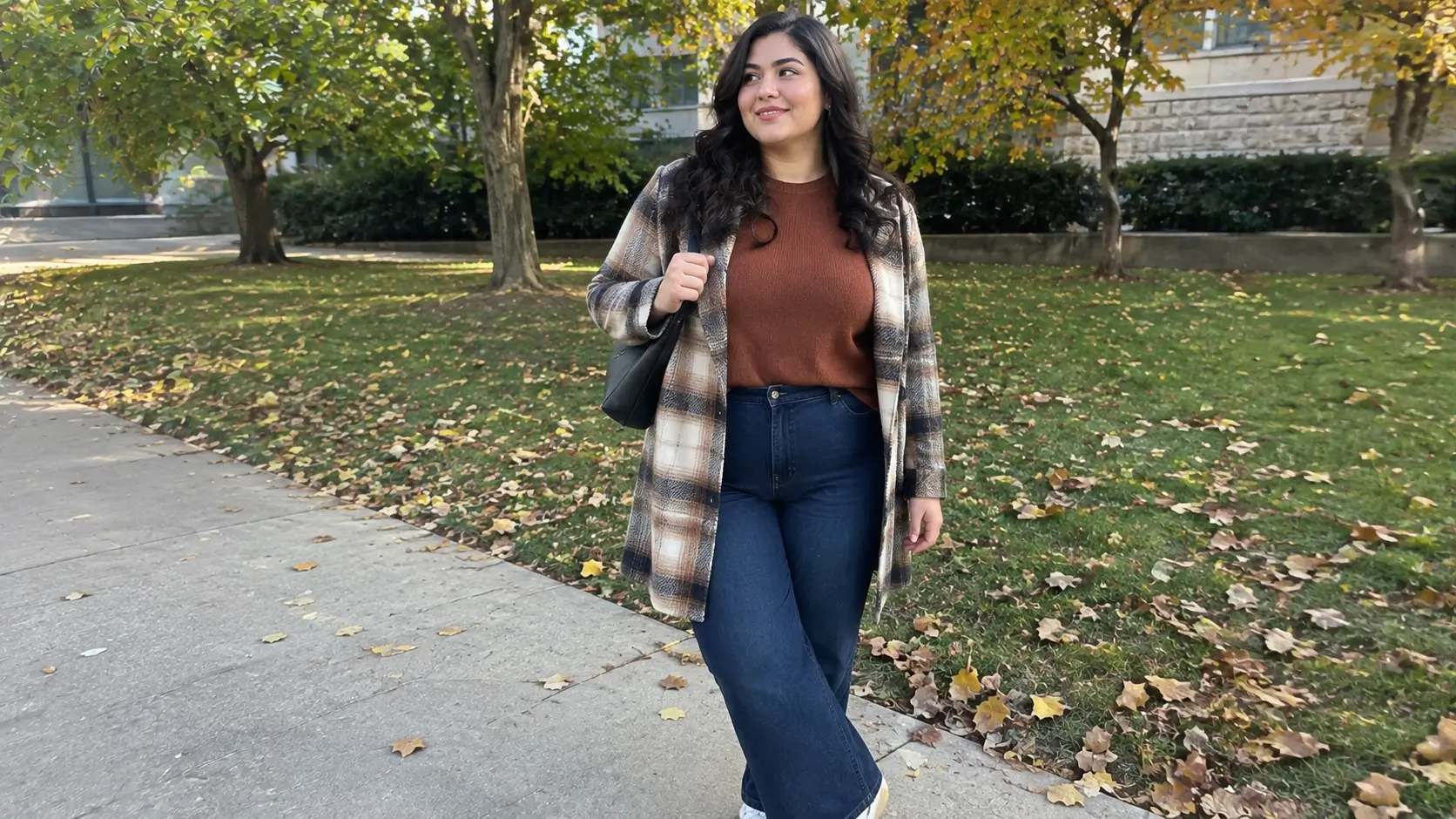
Fall dressing on a plus-size frame isn’t about disappearing into bigger layers — it’s about knowing which pieces hold their shape once a knit gets heavier or a coat goes on top of everything else. A loose sweater over loose pants reads as one shapeless block from across a room, and the fix usually isn’t a smaller size, it’s a waistline, a belt, or a hem that ends in the right place.
These 27 ideas are grouped by what they solve: structured layers that put a waist back into the picture, bottoms built to carry the whole outfit, dresses that skip the tucking-in problem, sweaters that don’t add bulk in the wrong spot, skirts paired with the right boot, coats that actually close, and a few uniforms for the days that don’t call for this much thought.
None of it needs a special “plus” version of anything. It’s the same proportions that work on any body, applied on purpose instead of by accident.
Structured Layers for a Defined Waist
A loose layer over a loose layer erases a waistline fast. These four add one back in without switching to anything tight.
1. Denim Jacket Cinched at the Waist
A boxy denim jacket left open just swallows a torso, so pull the fabric in with a wide elastic or stretch belt at the smallest part of your waist instead, then let the shoulders and hem stay as loose as they came. Wear it over a plain fitted tee and straight jeans so the belt has something to define.
The cinch does the work a fitted jacket usually does, but the denim never has to stretch across your back or arms, so you keep the room a bigger jacket gives without losing your shape underneath it.
2. Cropped Moto Over a Flare Dress
A fit-and-flare dress already narrows through the ribcage and releases at the hip, and a cropped moto jacket worn open sits right at that narrow point instead of cutting across your hip or thigh. Leather or faux leather both hold their shape here better than a soft knit jacket would.
Cropping the jacket at the waist means the zip pulls and quilting sit above the widest part of your hips, not across them, which is where a longer jacket usually goes wrong on a fuller lower half.
If the dress sleeves are already fitted, keep the jacket sleeves loose so your arms have one relaxed layer instead of two tight ones stacked on top of each other.
3. Barn Coat Over a Turtleneck
A canvas or waxed-cotton barn coat has a straight, boxy cut that skips the nipped waist a trench coat tries and usually fails to give a fuller midsection. Wear it open over a fitted turtleneck and straight-leg jeans so there’s still one close layer underneath the boxiness.
The turtleneck keeps your neckline from disappearing under a collar and coat at once, and the straight-leg jeans keep the bottom half of the outfit from turning into fabric on fabric.
4. Cardigan Belted at the Waist
Take an oversized cardigan that would normally hang open and close it with a thin fabric or leather belt at your natural waist, then let the rest fall open below the knot. Wear it over a simple tank and wide-leg trousers.
A long cardigan worn open just adds vertical fabric on both sides of your body. Belted, it turns into a shape with a top half and a bottom half, which reads as an outfit instead of a layer you forgot to close.
Bottoms Built to Be the Star
These four start with the pants or jeans and build up from there, which tends to work better on a fuller lower half than picking the top first and hoping the bottoms match.
5. Corduroy Trousers With a Bodysuit
Wide-leg corduroy trousers in a high rise sit above the widest part of your hips instead of cutting across them, and a fitted bodysuit tucks in without the bunching a regular top does at the waistband. Look for a rise that comes up past your belly button.
Corduroy has more structure than jersey, so the wide leg holds its shape instead of clinging to your thighs the way a soft knit pant would, and the ribbing runs vertically down your leg rather than around it.
A bodysuit means no shirt working its way out of your waistband by midafternoon, which matters more in wide-leg trousers than in any other pant cut, since there’s nothing snug at the hip to hold a tucked shirt in place.
6. Tucked Flannel and High-Rise Jeans
A flannel shirt tucked into high-rise straight jeans, rather than left open over them, gives you a defined waist and a clean vertical line down each leg. Roll the cuffs once so the jeans don’t pool over your shoes.
An open flannel adds width on both sides of your torso. Tucked in, the plaid stays contained to your top half and the jeans do the work of lengthening your legs instead.
7. Bootcut Jeans With Chunky Loafers
A bootcut leg balances a fuller hip better than a skinny or straight leg does, because the flare below the knee matches the width above it instead of narrowing sharply. Pair them with a chunky loafer that has enough sole to hold its own against the wider hem.
Keep the top half fitted, not baggy, so the jeans are the widest thing in the outfit rather than competing with a loose sweater for the same visual space.
8. Ponte Leggings and an Oversized Blazer
Ponte knit leggings have enough structure to skip the see-through problem regular leggings run into, and an oversized blazer worn over them covers the hip and thigh area some people want covered without adding bulk anywhere. Add combat boots to ground the look.
The blazer’s shoulders give the outfit a defined top edge, so the eye reads structure first and legging second, which is the opposite of what a soft cardigan over leggings usually does.
One-and-Done Dressing
A dress or jumpsuit skips the tucking-in problem entirely, but the cut still matters more on a curvier frame than the fabric does.
9. Wrap Dress With an Obi Belt
A wrap sweater dress already crosses at the waist, and swapping the thin tie that comes with it for a wider obi-style belt makes that waistline register from across a room instead of getting lost in the knit. Wrap it snug enough that the belt doesn’t slide.
Knit fabric moves with your body instead of standing away from it, so the wrap closure has to do real work at the waist or the whole dress reads as one straight column from shoulder to hem.
If the wrap gaps at the bust, a small safety pin under the fold holds it closed all day without showing, which matters more in a knit than in a woven fabric that has some structure of its own.
10. Corduroy Shirtdress With Tall Boots
A corduroy shirtdress has more body than a cotton one, so it skims rather than clings, and buttoning it to just above the knee with tall boots underneath turns a shapeless shirt silhouette into something with a visible waist and leg line.
Leave the top two buttons open and add a thin belt at the waist if the dress runs straight through the body, since corduroy holds a belt’s shape better than a slippery fabric would.
11. Fleece-Lined Jumpsuit and a Denim Jacket
A fleece-lined jumpsuit in a wide leg gives you one continuous line from shoulder to ankle with no waistband digging in anywhere, and a cropped denim jacket on top adds the only break the silhouette needs.
Look for a jumpsuit with some kind of waist tie or seam, even a soft one, so the outfit doesn’t read as a single tent-shaped piece of fabric once the jacket comes off indoors.
12. Shirtdress Layered Over a Turtleneck
A short or midi shirtdress meant for warmer weather still works in fall layered over a fitted turtleneck and leggings, with the dress worn open like a shacket rather than buttoned closed. The turtleneck becomes the actual outfit; the dress becomes the layer.
This solves the problem of a summer dress that no longer works alone once the temperature drops, without packing it away until next year.
Keep the leggings a similar color to the turtleneck so your legs read as one long line under the dress, rather than three separate blocks of color stacked on top of each other.
Sweater Weather, Done Right
A heavy knit adds bulk fast, so where it ends and what it’s tucked into matters as much as the sweater itself.
13. Cable-Knit Sweater Over a Denim Maxi
A chunky cable-knit sweater tucked into a denim maxi skirt keeps all the sweater’s bulk above the waist, where a wide skirt has room for it, instead of adding width at the hip on top of width at the chest.
The maxi skirt’s straight cut down to the ankle keeps the lower half of the outfit narrow and long, which balances a sweater that’s doing a lot of visual work up top.
14. Cowl-Neck Sweater and Wide-Leg Trousers
A cowl neck drapes rather than clings, so it skips the tightness a crew neck can create across the chest, and wide-leg trousers underneath keep the same relaxed, draped feeling going all the way down.
Tuck the front of the sweater in loosely, just enough to show there’s a waist under there, since a cowl neck left fully untucked can start to look like one long piece of fabric from neck to knee.
15. Fair Isle Cardigan and Slip Dress
A patterned fair isle cardigan buttoned over a simple slip dress puts all the visual interest on top, where your shoulders can carry it, while the slip underneath stays quiet and skims rather than clings through the hip and thigh.
The slip dress needs a bit of stretch in the fabric or it will ride up when you sit down, so check the label for at least a small percentage of spandex before buttoning the cardigan over it.
Leave the cardigan’s top button or two open at the neck. Buttoned all the way up, a patterned knit that heavy can start to look like a second collar competing with your actual collarbone.
16. Funnel-Neck Sweater and Rolled Jeans
A funnel neck sits higher than a crew or v-neck, which means it stops right at your jawline instead of leaving a gap of exposed chest in cold weather, and rolled straight-leg jeans underneath keep the outfit from feeling top-heavy.
Roll the jeans just once at the ankle, not cuffed multiple times, so the hem stays clean instead of adding bulk right above your shoe.
Skirts, Tights, and the Right Boot
A skirt in fall comes down to two decisions: how much leg stays covered, and how tall the boot underneath goes.
17. Pleated Midi Skirt and a Turtleneck
A pleated skirt already has built-in movement, so tucking a fitted turtleneck into the waistband keeps the top half close to your body while the pleats do the work of adding shape below.
Choose a skirt that hits mid-calf rather than ankle length. A fuller frame can get lost in an ankle-length pleated skirt in a way it won’t in one that ends a few inches higher.
Knee-high boots underneath close the gap between hem and shoe, so there’s no visible strip of tights doing all the work between the skirt and your footwear.
18. A-Line Denim Skirt With Tights
An A-line denim skirt that hits just above the knee skims out from the waist instead of clinging through the hip, and opaque tights underneath mean the skirt doesn’t need to be any longer to feel weather-appropriate.
Denim holds its A-line shape through the day in a way a soft cotton skirt won’t, so it keeps skimming out from the waist even after hours of sitting.
A moto jacket on top, worn open, adds structure at the shoulder that balances the skirt’s flare at the hem, rather than adding more width down low with a longer cardigan instead.
19. Leather-Look Skirt With a Cropped Puffer
A faux leather midi skirt has enough structure to hold a straight line down from the waist, and a cropped puffer jacket on top stops at the natural waist instead of adding puffer bulk over the skirt’s hip line.
Keep the puffer’s crop point at or just above where the skirt’s waistband sits, so there’s no gap of exposed torso and no overlap where two waistbands stack on each other.
20. Plaid Mini Over Leggings
A plaid mini skirt worn over full-length leggings, rather than alone with tights, covers more leg while keeping the plaid visible as a top layer, and a long cardigan on top ties the leggings and skirt into one outfit instead of two separate pieces.
This works especially well on a colder day when a mini skirt alone isn’t warm enough but you still want the plaid in the mix somewhere.
Outerwear That Actually Closes
A coat that won’t button over your actual arms and chest isn’t outerwear, it’s a cape. These four are picked for how they fit closed, not just how they look open.
21. Longline Puffer Over a Monochrome Base
A longline puffer coat, worn zipped over a single-color base of sweater and trousers in the same tonal family, keeps the whole outfit reading as one long line instead of breaking it up with contrast at the waist.
Puffers add bulk by design, so starting with a slim monochrome base underneath is what keeps the whole thing from doubling in width once the coat goes on.
22. Belted Wool Coat Over Trousers
A wool coat with its own belt, cinched rather than left hanging open, gives you a defined waist under a heavy outer layer without needing anything fitted underneath it. Wide-leg trousers keep the proportions balanced below the belt.
Check that the coat has enough room through the shoulders and upper arms to close comfortably before relying on the belt to shape it. A coat that strains across the back will pull the belt out of place within an hour.
23. Quilted Field Jacket and a Turtleneck
A quilted field jacket sits at the hip rather than the waist, which is a length that works on a fuller midsection better than a cropped jacket that stops short and exposes it. Wear it over a fitted turtleneck so there’s still one close layer underneath the quilting.
Look for a field jacket with a drawstring or elastic at the hem. Cinched slightly, it keeps the jacket from ballooning out below your hip the way an unstructured quilted jacket can.
24. Shearling Denim Jacket Over a Midi
A shearling-lined denim jacket is heavier than a regular jean jacket, so it needs a midi skirt or dress underneath with some drape rather than more bulky fabric, or the whole outfit starts to feel stiff.
The shearling collar adds width right at your shoulders and neck, which balances out nicely if the rest of the outfit narrows below the waist instead of widening to match it.
Leave the jacket unbuttoned rather than snapped closed. Shearling denim is thick enough that closing it fully can pull tight across the chest and back in a way a lighter jacket wouldn’t.
Easy Weekend Uniforms
Not every fall outfit needs this much thought. These three are for the days you want dressed and comfortable in under five minutes.
25. Oversized Flannel Over a Graphic Tee
An oversized flannel worn open like a jacket over a fitted graphic tee and leggings is the easiest version of layering there is, since nothing under the flannel needs to be tucked or belted for it to look put together.
Size the flannel up from your usual, not down, so it hangs open like outerwear instead of closing like a shirt that’s too small to button.
26. Matching Sweatsuit With Bold Sneakers
A matching sweatshirt and jogger set in a heavier fleece holds its shape better than mismatched loungewear does, and a pair of sneakers with some color or shape to them keeps the whole outfit from reading as pajamas.
Gold hoops or a single layered necklace do the same job here that jewelry does for any other outfit — they signal the sweatsuit was a choice, not just whatever was closest on laundry day.
27. Tunic Sweater With Socks Over Boots
A tunic-length sweater that hits mid-thigh, worn over leggings with tall socks pulled up over the top of ankle boots, covers the exact spot where a shorter sweater and boot combination usually leaves a gap of bare leg between them.
The socks need to be thick enough to sit up on their own without slouching down into the boot within an hour, so look for a ribbed or cable-knit pair over a thin cotton one.
This one runs warmer than it looks, since there are technically three layers on your legs once the leggings, socks, and boots are all accounted for, so save it for the colder end of fall rather than an early September day.
Final Thoughts
None of these need a special version of anything — they’re the same proportions that work on any body, applied on purpose instead of by accident. A waistline, a hem that ends in the right place, a layer that closes instead of catches: that’s most of the list.
Start with whatever’s already in your closet that gets close to one of these combinations, then build the pieces you’re missing from there instead of replacing everything at once.