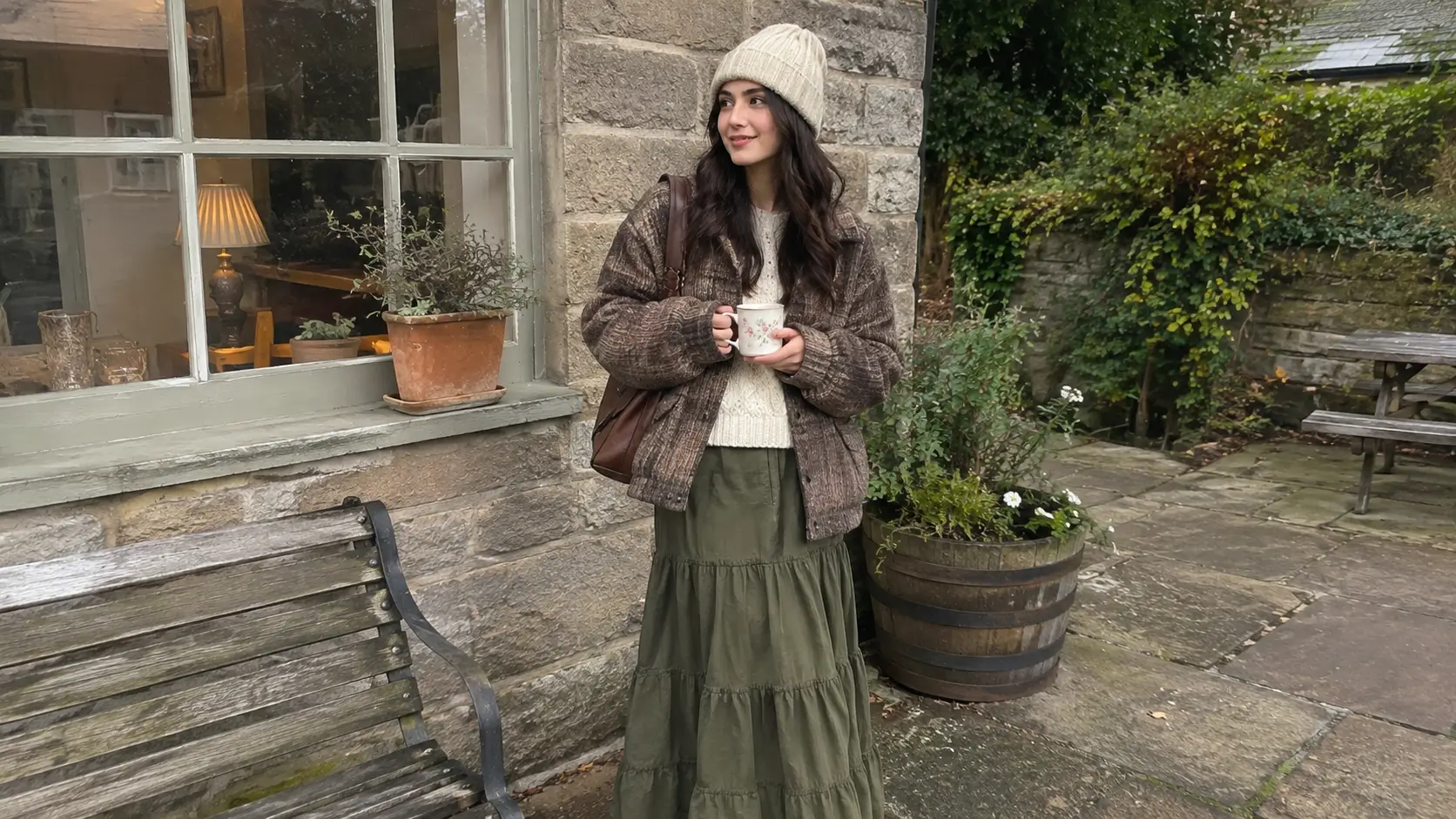
Cottagecore doesn’t disappear once the garden goes dormant. It just changes clothes — the linen sundresses and flower crowns move to the back of the closet, and the wool, cable knits, and flannel-lined layers come forward instead.
The trick to winter cottagecore is layering pieces that still look like they belong on a farmhouse porch or in front of a woodstove, not a ski lodge. A prairie dress works just as hard in January as it does in June once there’s a coat and a pair of thick tights involved.
These twenty-five outfits move through a full cottagecore winter — kitchen mornings, market trips into town, snowy walks, chore-coat practicality, and firelit holiday dinners — so there’s a starting point whatever the day actually looks like.
Kitchen and Hearth Mornings
Mornings in a cottagecore winter start close to the stove, so these looks lean into soft, worn-in layers that can survive flour on the counter and a kettle going.
1. Flour-Dusted Apron Over a Waffle-Knit Henley
A canvas half-apron, the kind with a big front pocket for wooden spoons, goes on over a waffle-knit henley in oatmeal or rust. The henley is buttoned to the collarbone and the sleeves are pushed up past the elbow, since there’s usually dough involved somewhere in the morning.
The apron does double duty as the outfit’s only real shape — everything under it can be loose because the ties cinch it at the waist. Thick wool socks and slipper-style clogs finish it off without anyone having to actually get dressed for the day yet.
2. Cable Cardigan Buttoned Over a Nightgown
A long cable-knit cardigan, buttoned all the way up, goes directly over a flannel or brushed-cotton nightgown that’s already being worn. The cardigan hits mid-calf, so the nightgown only shows at the hem and the sleeves.
This is less an outfit than a decision not to change clothes before coffee, and cottagecore mornings are built around exactly that kind of decision. A wide leather or braided belt at the waist turns it from bedwear into something that could answer the door.
If the cardigan is a lighter weight, a thermal layer underneath keeps the whole thing from being a costume rather than actual winter clothing — the goal is warm, not just photogenic.
3. Wool Bedjacket and Thick Ribbed Leggings
A cropped wool bedjacket — the kind with a ribbon tie at the neck, more waistcoat than cardigan — goes over a fitted long-sleeve top and thick ribbed leggings. It’s a shape that’s mostly disappeared from regular closets but sits naturally in a cottagecore one.
The bedjacket only covers the shoulders and upper back, so the leggings and top need to be doing real work against the cold underneath it. A fleece-lined legging solves that without changing the silhouette.
Wool slippers with a hard sole make this one work for a quick trip to the mailbox, which is usually as far as a bedjacket outfit needs to travel.
4. Corduroy Overalls With a Turtleneck Underneath
Wide-leg corduroy overalls in mustard or rust go over a ribbed turtleneck in cream or forest green, with the turtleneck’s sleeves showing the full length past the overalls’ straps.
Corduroy holds heat better than most people give it credit for, and the overalls’ loose fit leaves room for a thermal layer on the coldest mornings without the outfit looking bulkier for it.
Market Day and Town Errands
For trips into town — the farmers market, the post office, the feed store — these looks add structure on top of the softness so nothing has to be re-tucked after getting in and out of a car.
5. Wool Coat Over a Prairie Dress
A knee-length camel wool coat, single-breasted with wooden or horn buttons, goes over a long prairie dress in a small floral or check print. The dress’s ruffled hem shows a few inches below the coat.
Duck boots or lace-up leather boots replace whatever the dress was styled with in warmer months, and a wool watch cap keeps the whole thing from reading as a summer outfit someone forgot to change out of.
6. Plaid Flannel Knotted Over a Dress
A soft flannel shirt in a muted plaid — rust and cream rather than red and black — goes over a fitted ribbed knit dress, left unbuttoned and knotted once at the waist rather than tied tight.
The dress alone would be too thin for a town trip, so the flannel is the actual coat-substitute here, not decoration. A canvas tote and low boots keep the rest of the outfit out of the way of carrying groceries.
7. Newsboy Cap With a Chunky Scarf
A wool herringbone newsboy cap sits low over loose waves, paired with an oversized chunky-knit scarf wrapped twice and a woven basket bag with a leather strap swapped in for winter.
This one works over almost anything underneath — a peacoat, a barn jacket, a long cardigan — because the cap and the basket bag are doing the styling work, not the coat. It’s the outfit for someone who wants one strong detail rather than five coordinated ones.
8. Corduroy Trousers and a Fisherman Sweater
Wide-leg moss-green corduroy trousers, cropped just above the ankle, pair with a cream cable-knit fisherman sweater tucked in at the front only, left loose at the back.
Brown leather ankle boots and a canvas jacket over the top keep the palette earthy rather than bright, which is the difference between this reading as cottagecore and reading as just a green-and-cream outfit.
Snowy Walks and Orchard Trails
Actual snow changes the math — these are the looks built to survive a real walk, not just a photo taken near the porch.
9. Sherpa Barn Coat Over a Dress
A boxy sherpa-lined barn coat, the kind with a corduroy collar, goes over a long-sleeve floral midi dress with thick fleece-lined tights underneath.
The dress supplies the print and the coat supplies the warmth, so neither one has to compromise — a common problem with cottagecore winter dressing, where the pretty piece and the warm piece are rarely the same garment.
10. Knit Balaclava Under a Wool Beret
A thin knit balaclava goes on first, pulled down to sit at the neckline like a turtleneck, with a slouchy wool beret on top of it rather than instead of it.
It looks unusual written out, but it solves the actual problem of a beret doing nothing for cold ears — the balaclava handles warmth, the beret handles shape, and together they read as an intentional layered look rather than two separate solutions.
11. Quilted Vest Over Layered Thermals
A diamond-quilted vest in a deep plum or forest green goes over a long-sleeve waffle thermal and a second, shorter knit layer underneath that, with the sleeves of both visible at the wrist.
Rubber wellies with thick wool socks folded over the top handle actual mud and snowmelt, which is the point of an orchard-trail outfit that has to survive more than a driveway.
12. Alpaca Poncho With Fingerless Mitts
A chunky alpaca poncho, long enough to sit at the hip, goes over a fitted turtleneck and straight-leg jeans, with fingerless knit mitts and a small woven crossbody worn over the poncho rather than under it.
The poncho’s open sides mean it moves easily, which matters on an actual walk where arm movement isn’t optional — a closed coat would trap the cold in exactly the way this doesn’t.
Fingerless mitts only work down to a certain temperature, so this one is better suited to a brisk walk than standing still at a bus stop for twenty minutes.
Fireside Evenings
Evenings by the fire call for the softest layers of the whole list — nothing structured, nothing that needs re-arranging after sitting down.
13. Chunky Cardigan Belted Like a Robe
An oversized chunky knit cardigan with no buttons goes on open, then gets a slim leather belt cinched at the natural waist the way a robe would be tied, over wide-leg wool or flannel pants and a fitted tank underneath.
Belting the cardigan is what keeps it from swallowing the whole outfit — without it, it’s just a blanket with sleeves. With it, there’s a defined waist and the drape still reads as loungewear rather than daywear.
This one holds up especially well on a body that finds most fitted knitwear uncomfortable to sit in for hours, since the belt is the only part doing any actual shaping.
14. Velvet Smoking Jacket Over a Nightdress
A deep burgundy or forest velvet smoking jacket, quilted at the lapel, goes over a long linen or cotton nightdress with the jacket left open rather than tied.
It’s an unexpected pairing — velvet is usually saved for going out, and a nightdress is usually saved for bed — but together they land somewhere between the two, which is exactly the mood a fireside evening is going for.
15. Patchwork Quilted Skirt With Ragg Socks
A long patchwork quilted skirt, pieced from mismatched florals and checks the way an actual quilt would be, pairs with a plain fitted sweater tucked in and knee-high ragg wool socks instead of tights.
The skirt is heavy enough to sit close to the fire without needing anything else on the legs, and the ragg socks — thick, flecked, usually cream and gray — are doing more of the winter work than they get credit for.
Barn Chores and Practical Layers
Feeding animals or hauling firewood doesn’t leave room for anything precious — these looks are built to actually work in.
16. Canvas Chore Coat Over Insulated Overalls
A stiff canvas chore coat in tan or faded blue goes over insulated denim or duck-canvas overalls, with a thermal or flannel layer underneath the overalls’ bib.
This one is closer to workwear than most cottagecore outfits get, and that’s the point — a barn or a woodpile doesn’t care how the outfit photographs, and the chore coat’s boxy cut leaves enough room to actually bend and lift in it.
17. Waxed Jacket With a Flannel-Lined Skirt
A short waxed cotton jacket, weatherproof and slightly stiff, goes over a midi skirt lined in flannel rather than cotton, with thick tights and lace-up boots underneath.
The flannel lining is the detail that makes a skirt viable for outdoor chores in the first place — most cottagecore skirts aren’t built for it, and this one specifically is.
18. Rubber Boots With Folded Wool Socks
Tall rubber boots with thick cream wool socks folded down over the top pair with straight-leg jeans tucked in, a cropped corduroy barn jacket, and a plaid flannel underneath it.
Folding the sock over the boot is a small styling choice that does real work — it keeps snow and mud from getting inside the boot’s opening, not just looking good doing it.
The jacket runs cropped on purpose, since a longer coat gets in the way of bending down for a feed bucket or a stack of firewood.
Holiday Gatherings and Firelit Dinners
Family dinners and holiday parties call for something dressier without losing the handmade, lived-in feeling the rest of the wardrobe has.
19. Velvet Wrap Dress With Lace-Up Boots
A rust or deep amber velvet wrap dress, tied at the side rather than the front, pairs with lace-up leather boots and a thin gold chain instead of anything larger.
Velvet catches candlelight in a way flat cotton doesn’t, which is most of why it works for an evening indoors — the same dress under overhead fluorescent light would read completely differently.
A cropped cardigan over the shoulders, not worn but draped, covers the walk from the car without covering the dress once it’s actually time to sit down.
20. Tartan Taffeta Skirt With a Brooch
A midi-length tartan taffeta skirt, the kind with enough structure to hold its shape when sitting down, pairs with a fitted cream turtleneck and a small vintage pearl or floral brooch pinned near the collar.
The brooch is doing more work than its size suggests — it’s the one detail that pushes a fairly simple sweater-and-skirt combination into looking dressed for an occasion rather than just for the cold.
21. Wool Cape Over a Slip Dress
A floor-length wool cape, hand-embroidered along the hem with small florals, goes over a simple bias-cut slip dress in cream or burgundy, with the cape’s hood down and the clasp left open at the collarbone.
The cape replaces a coat entirely for the walk from the car to the door, and once inside, it comes off to reveal a dress that was never trying to be an outerwear layer in the first place.
22. Corduroy Pinafore Over a Poet-Sleeve Blouse
A cranberry corduroy pinafore dress, cross-back rather than button-front, goes over a cream blouse with full poet sleeves that gather at a thin cuff, buttoned to the wrist.
The pinafore’s straps sit close enough to the shoulder that the blouse’s volume doesn’t get lost underneath it — a boxier pinafore would flatten the sleeves instead of showing them off.
Cream tights and mary jane–style flats finish it in a way that reads more like a holiday portrait than an ordinary Tuesday, which is exactly the point of a pinafore this dressed up.
Quiet Sunday Mornings
Some winter mornings aren’t going anywhere at all, and these looks are built for that — a book, a mug, and no particular plan.
23. Fisherman Sweater Worn as a Dress
An oversized cream fisherman-knit sweater, long enough to hit mid-thigh on its own, gets worn as a dress with thick thigh-high ribbed socks and no leggings underneath.
It only works with a sweater heavy enough to hold its shape rather than cling — a lighter knit needs a slip or leggings underneath to stay decent, but a true fisherman knit has the structure to stand on its own.
24. Hand-Knit Shawl Pinned Over a Nightgown
A triangular hand-knit shawl, the kind with a scalloped or fringed edge, gets pinned closed at the chest with a small brooch over a long flannel nightgown.
The pin is what separates this from just wearing a blanket around the shoulders — it holds the shawl in place through getting up for more coffee or reaching for a book on a low shelf, which an unpinned shawl won’t survive.
25. Wool Trapper Hat With Braided Pigtails
A wool trapper hat with the ear flaps down goes over hair in two loose braids, paired with a long wool coat thrown on over pajama pants for a walk to get the mail or bring in firewood.
The trapper hat’s flaps are the actual reason this outfit works in real cold — they cover more ear than a beanie does, and the braids keep hair out of the way underneath them rather than getting tangled in the ties.
It’s not an outfit meant to be seen by anyone except maybe a neighbor also out for the same five minutes, which is honestly true of most of what actually gets worn on a slow Sunday.
Final Thoughts
Winter cottagecore works best as layers built for an actual day rather than one outfit trying to do everything at once — a kitchen morning doesn’t need the same coat as a walk to the barn, and a holiday dinner doesn’t need the same boots as either one.
The common thread across all twenty-five is texture over trend: wool, corduroy, hand-knits, and flannel doing the outfit’s real work, with whatever’s pretty about it built on top of that rather than instead of it.