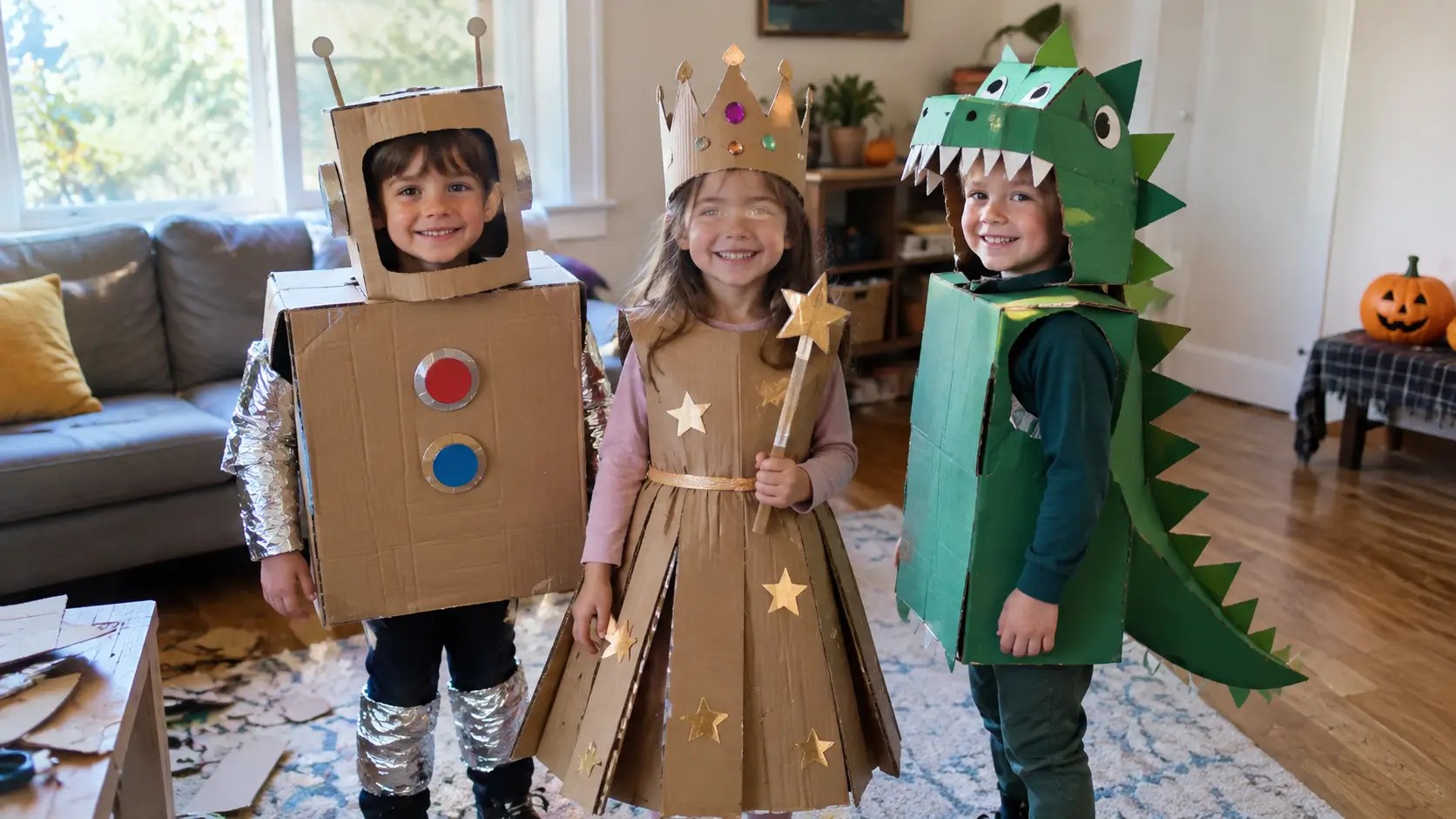
A flattened moving box and a hot glue gun turn into more costume than most Halloween stores sell in a week. The trick is picking a shape a kid can actually wear for three hours of trick-or-treating — something light enough to run in, wide enough to bend down and grab candy, and cut with real armholes instead of just two slits and a prayer.
The 21 costumes below all start from the same handful of box sizes: a single-item shipping box, a case-of-water box, and the flat rectangular kind that TVs and monitors ship in. Paint, a few markers, and whatever’s already in the recycling bin do the rest — cereal boxtops, bottle caps, pool noodles, ribbon.
Sizing note before you start cutting: measure shoulder to shoulder and add two inches on each side before taping the armholes shut. A costume that fits square on a kid standing still gets tight the second they lift both arms for a doorbell.
Things That Go
Box shapes that already look like a vehicle from the side need the least amount of shaping — cut a hole for legs, add wheels, and let the kid do the moving.
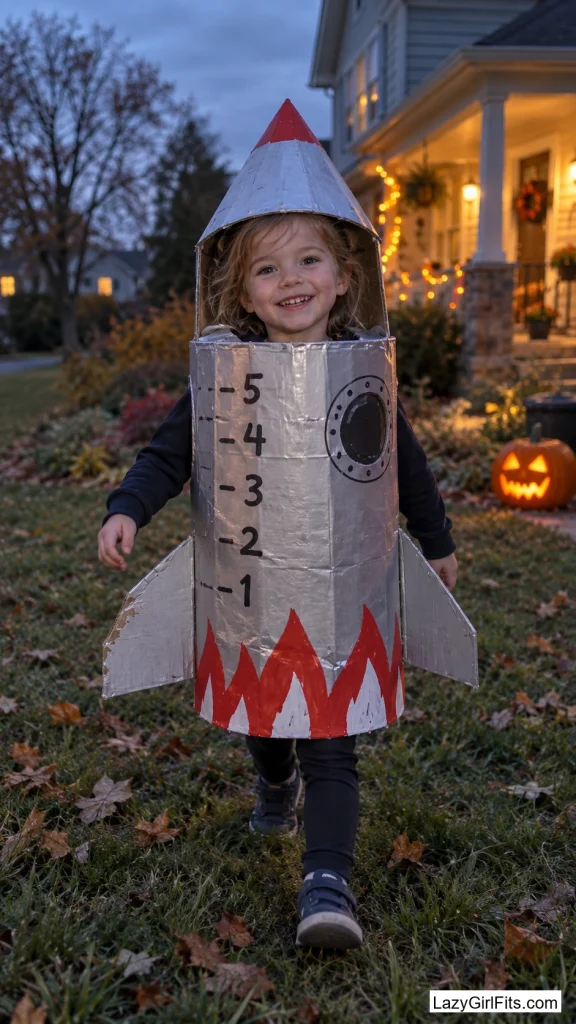
1. Countdown Rocket Ship
A tall box from a case of paper towels or a floor lamp becomes the body. Cut a hole in the bottom for the child’s legs and one at the top for their head, then round off the nose with a cone of poster board taped to the top flap. Three fins cut from a flattened cereal box and taped to the back finish the shape.
Paint it silver or leave it cardboard-brown with a strip of red and white flame along the bottom edge — either reads as a rocket from ten feet away, which is the distance most people actually see a Halloween costume from. A countdown painted down one side in marker, 10 to 1, gives kids something to point to and explain instead of just standing there.
2. Race Car With Headlight Stickers
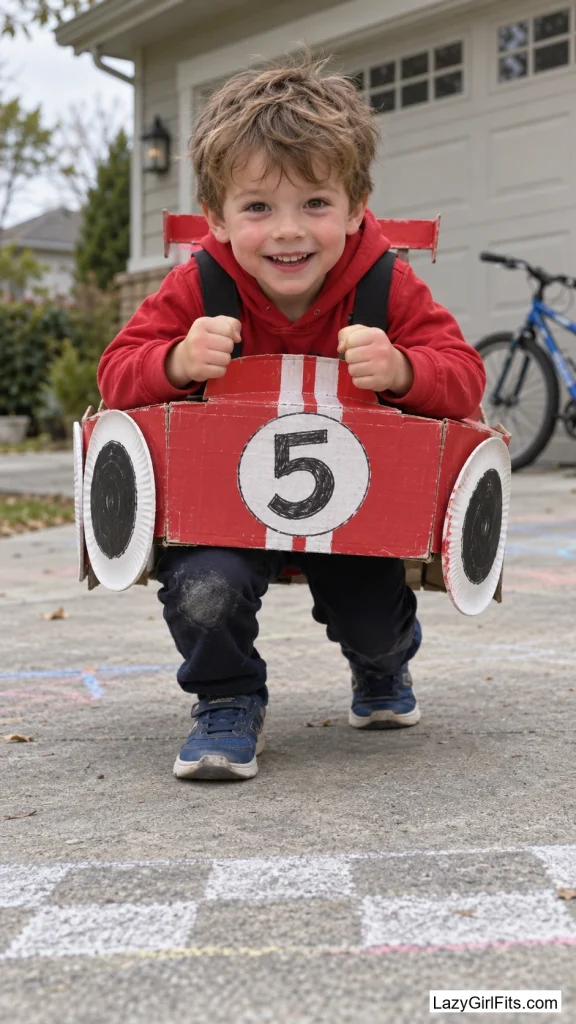
A flat produce box or diaper box, cut down to hip height and worn like a pair of overalls with the straps over the shoulders, is the whole build. Two paper plates painted black and taped to the sides become wheels, and a rectangle cut from the front becomes the windshield the child’s face shows through.
Round reflective stickers meant for mailboxes work as headlights and actually catch a flashlight beam after dark, which matters more for a car costume than almost any other detail. A racing number written large on both doors in tape or marker reads clearly in photos, and the low, wide shape stays out from underfoot on stairs better than a costume with a tall structure on top.
3. City Bus to Trick-or-Treat
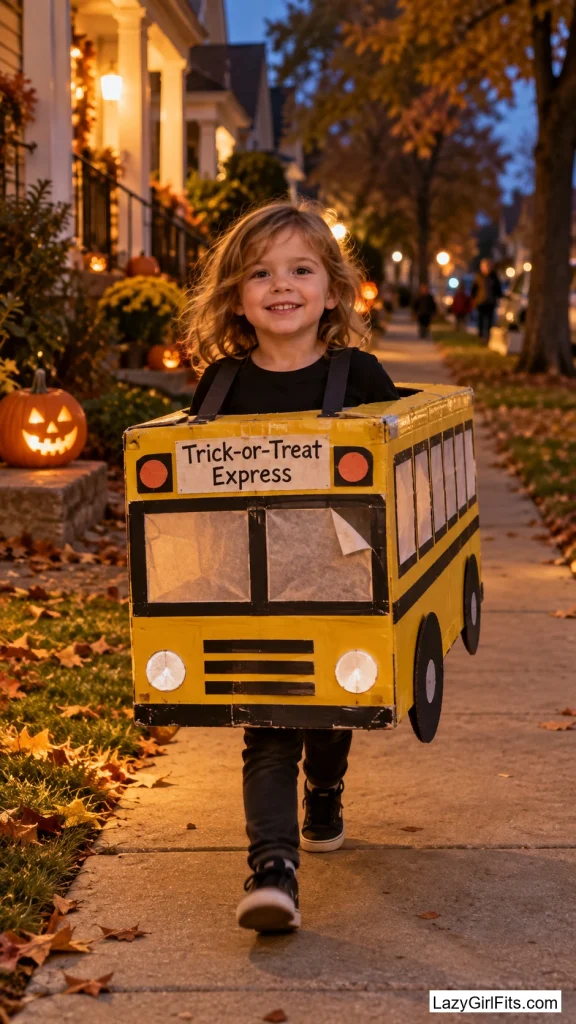
A long, shallow box — the kind a folding table or a rolled rug ships in — becomes a bus body worn like a sandwich board with straps over both shoulders. Rows of squares cut along the sides and backed with tissue paper make windows that let a little light show through, and a strip of yellow poster board along the top edge gives it a real transit-bus stripe.
The front panel is where the joke lives: a hand-painted destination sign reading “Trick-or-Treat Express” sits in the spot where a real bus lists its route number. Because the shape is flat and worn like a vest rather than boxed in on both sides, a kid can still bend at the waist to pick up dropped candy without the whole costume folding in half.
Snack Aisle Costumes
Food costumes get bulky fast, so the ones that work best for kids are flat panels worn front and back rather than a box that wraps all the way around.
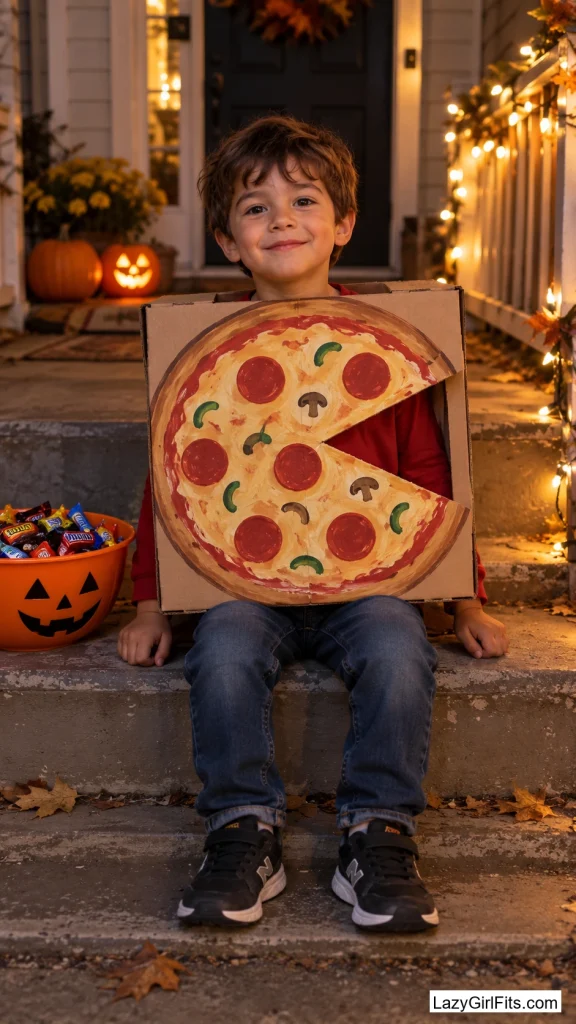
4. One Slice Missing Pizza Box
A flat pizza box, or a piece of cardboard cut to that shape and scored to fold like one, becomes a costume worn like a sign board over the shoulders — front panel showing the open pizza, back panel showing the printed lid. The pizza itself is painted directly onto the cardboard: a tan circle, red sauce swirled on with a sponge, and pepperoni circles punched from red construction paper and glued down in rows.
One triangular wedge is cut out of the front panel entirely, so the child’s own shirt shows through the gap — a plain red shirt reads as the missing slice’s sauce without any extra building. It’s a costume that photographs well precisely because the joke is visible from across a room, not something a parent has to explain.
Steam lines cut from white tissue paper and taped just above the missing slice, angled to flutter slightly as the child walks, sell the “fresh out of the oven” idea for almost no extra material. If the night turns cold, a long-sleeve red shirt under the costume keeps the sauce-colored gap from being the only thing standing between a kid and the wind.
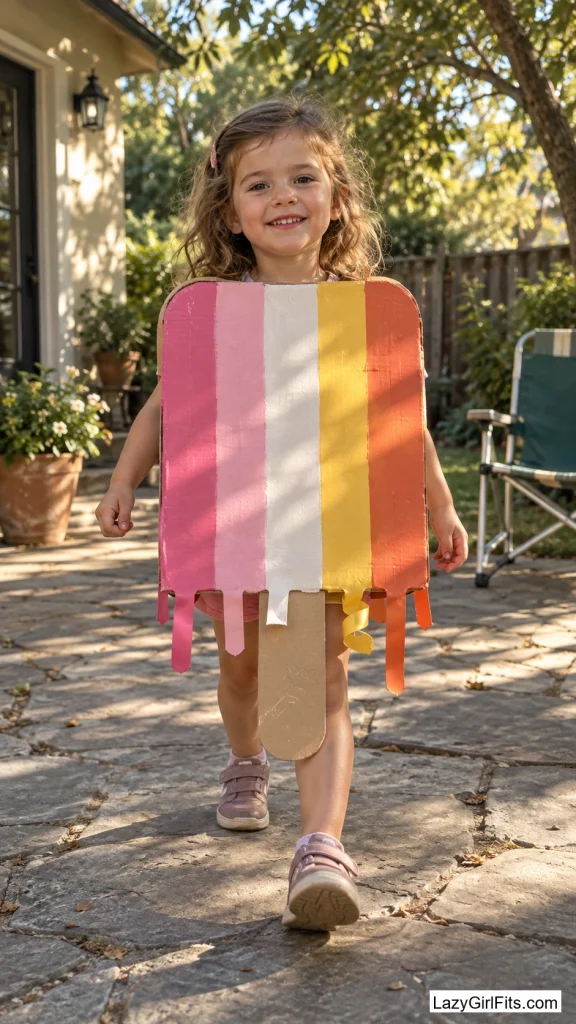
5. Melting Ice Pop
A single flattened box cut into a tall rounded rectangle, striped in two alternating colors with poster paint, makes the pop itself; a shorter tan rectangle taped to the bottom becomes the wooden stick. The whole panel is worn like a sandwich board, with the stick section sitting at hip height where a hand would naturally hold it.
What separates this from a plain popsicle costume is the drip: strips of matching ribbon, cut to different lengths and glued along the bottom edge of each color stripe, hang loose enough to sway while the child walks. It reads as melting mid-stripe without any wet or sticky material anywhere near the costume, which matters for a piece that’s going to spend three hours moving between porches.
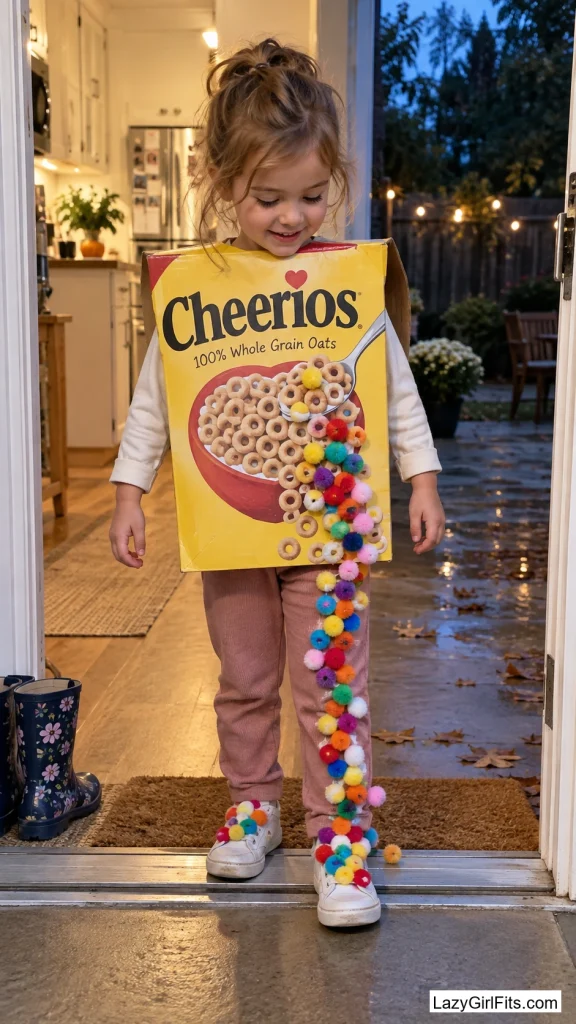
6. Cereal Mascot With a Spill Trail
The front and back panels of an actual cereal box, enlarged by tracing them onto poster board at roughly triple size, become the costume’s two flat sides, connected over the shoulders like a poncho. The box art — mascot, logo, nutrition panel corner — gets repainted or a color photocopy glued directly onto the poster board rather than hand-drawn, which keeps the brand recognizable without redrawing a cartoon face freehand.
A handful of pom-poms in a matching color, hot-glued in a loose trail down one pant leg and across the tops of both shoes, finishes the idea that the box has been knocked over and is still spilling. It’s a small addition that turns a flat box costume into a scene rather than just a label, and pom-poms weigh nothing, so they don’t change how the shoes fit.
Machines With a Mind of Their Own
These start from the same rectangular box as the vehicles above, but the details — buttons, screens, slots — are what make each one read as a specific machine instead of a generic robot.
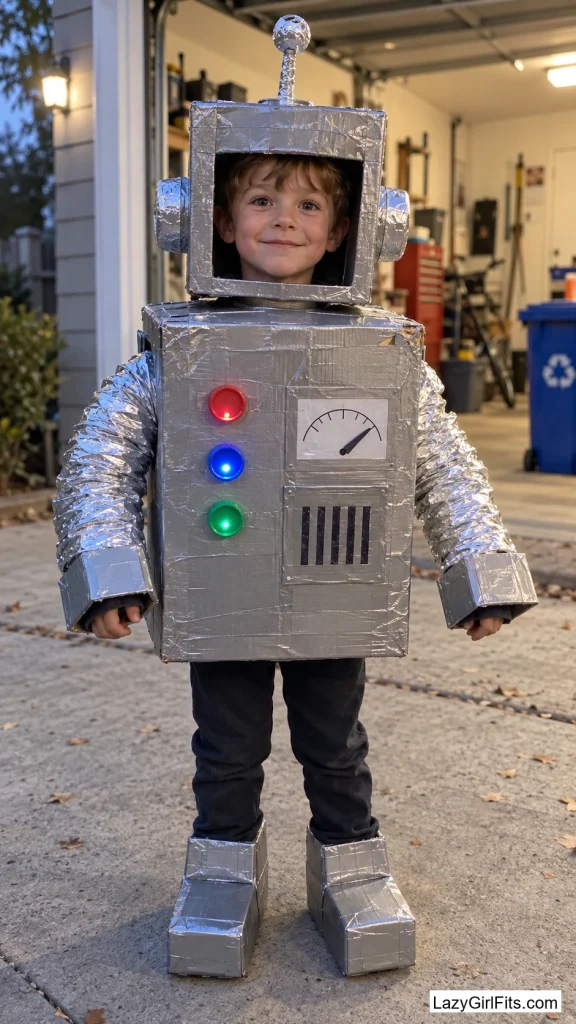
7. Cardboard Robot With Bottle-Cap Buttons
A medium shipping box for the torso and a smaller square box for the head, connected by a strip of cardboard at the neck, make the basic robot shape. Dryer-vent tubing or two paper-towel tubes covered in foil become arm connectors at the shoulders, and a row of bottle caps painted silver and glued down the chest panel stand in for control buttons.
Silver duct tape wrapped around the box edges hides the printed logos and cardboard color faster than painting the whole thing, which matters when this is the costume built the night before. A single strip of battery-powered LED string lights tucked behind a cutout on the chest panel gives the buttons an actual glow without any wiring near the child.
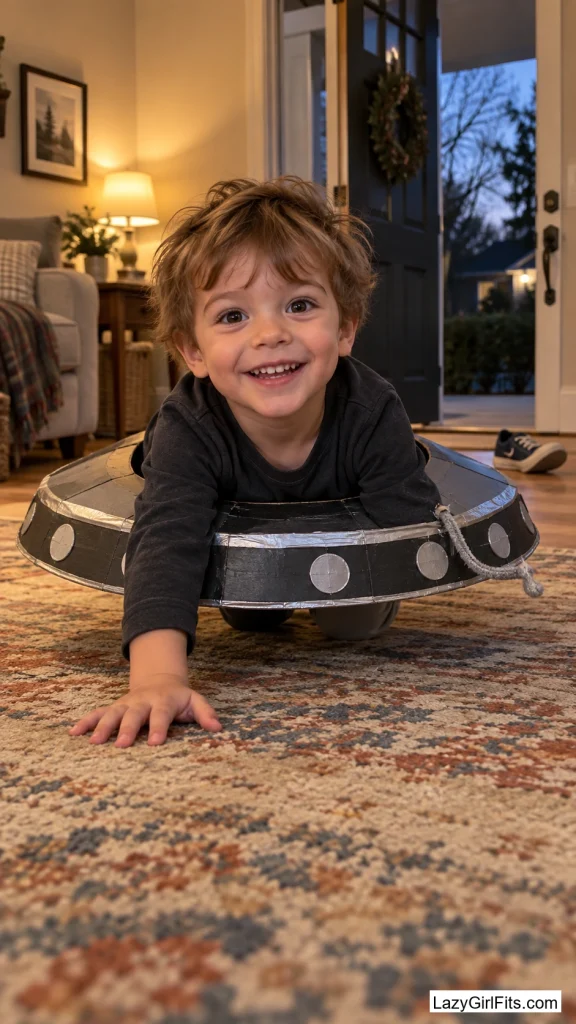
8. Robot Vacuum Stuck Under the Couch
A wide, shallow box — a pizza box works, or a flattened case-of-soda box cut down — becomes a low, round disk worn around the waist like a life preserver rather than stood up as a tower. The top is painted matte black or gray with a single ring of silver marker near the edge to suggest the bumper sensor real robot vacuums have.
The joke is in the posture: because the disk sits low and horizontal instead of tall and vertical, the whole costume reads instantly as the appliance version of a robot rather than a small person in a box. A few felt scraps glued to one edge, cut into the ragged shape of a sock or a shoelace, finish the “stuck on something” idea without any extra structure.
This shape is unusually good for actual trick-or-treating because it sits at hip height and doesn’t block a kid’s arms, legs, or field of view — most costumes built from a box sacrifice one of those three. An elastic waistband sewn or safety-pinned to the inside keeps it from sliding down during a full night of walking.
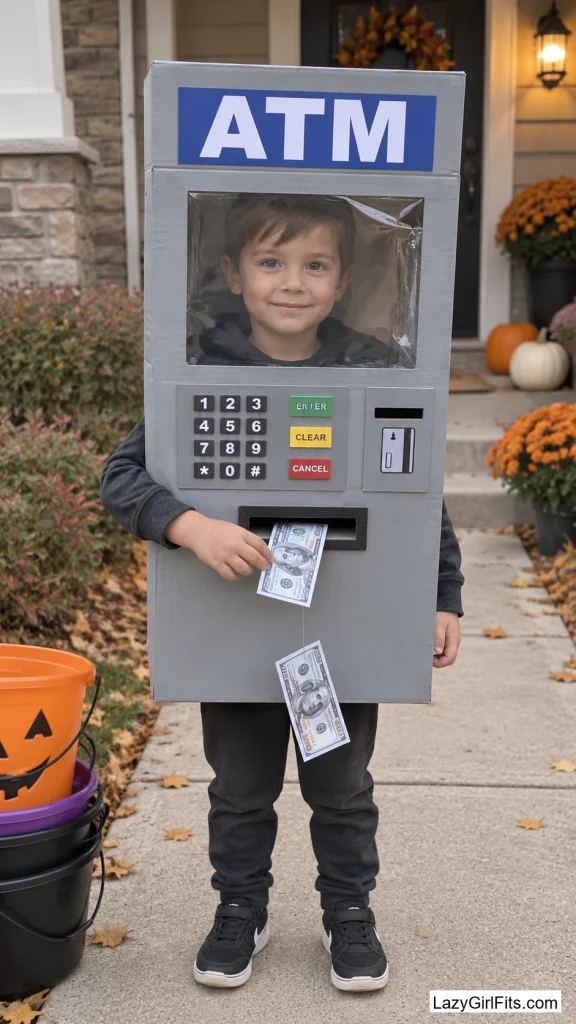
9. ATM Dispensing Fake Bills
A tall narrow box, the kind a floor lamp or a broom ships in, worn like a sandwich board becomes the machine face. A rectangle cut and backed with dark cellophane makes the screen, and a horizontal slot cut lower down, at about beltline, is where the joke lives.
Play money, cut down from green construction paper or an actual toy cash-register set, gets threaded on a length of clear fishing line and pinned so several bills dangle just below the slot, as if mid-dispense. A number pad drawn on with marker or made from more bottle caps fills the space between the screen and the slot without adding any real weight to the front panel.
Kids old enough to hand out the fake bills to friends get more mileage out of this one than most costumes, since it turns into a small interactive bit at every stop rather than something that’s just looked at. If the fishing line keeps tangling before the night starts, taping the bills at slightly different lengths instead of the same length keeps them from sticking together.
Household Objects With Something to Say
The plainest objects in the house make the funniest costumes, because nobody expects to see them walking around — the whole bit is the surprise of recognizing something ordinary.
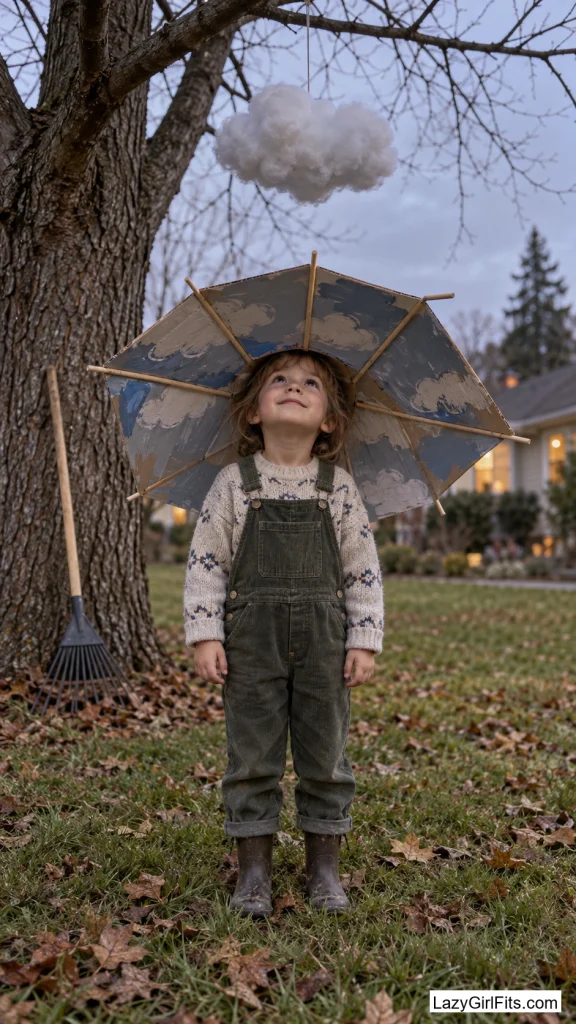
10. Umbrella Turned Inside Out
A large circle of cardboard, cut from a flattened refrigerator or mattress box, gets scored in eight wedges radiating from the center like real umbrella panels, then bent slightly backward at each seam so the whole disk cups the wrong way. It’s worn like a hat with a wide chin strap, sitting above the head rather than over the shoulders, so the “inside out” shape is visible from every angle.
Thin wooden dowels or chopsticks, glued along each scored seam and left to poke a few inches past the cardboard edge, stand in for the umbrella’s bent ribs and are what actually sell the shape as storm-damaged rather than just a floppy hat. Gray and blue paint in a mottled pattern across the top finishes the fabric look without needing real umbrella material anywhere in the build.
A separate small cloud shape, cut from poster board and hot-glued to a length of wire so it hovers just above one shoulder, gives the costume a reason to be windblown instead of leaving it as an unexplained broken object. Because most of the structure sits above head height rather than wrapped around the torso, a kid can wear a jacket underneath without anything fitting oddly.
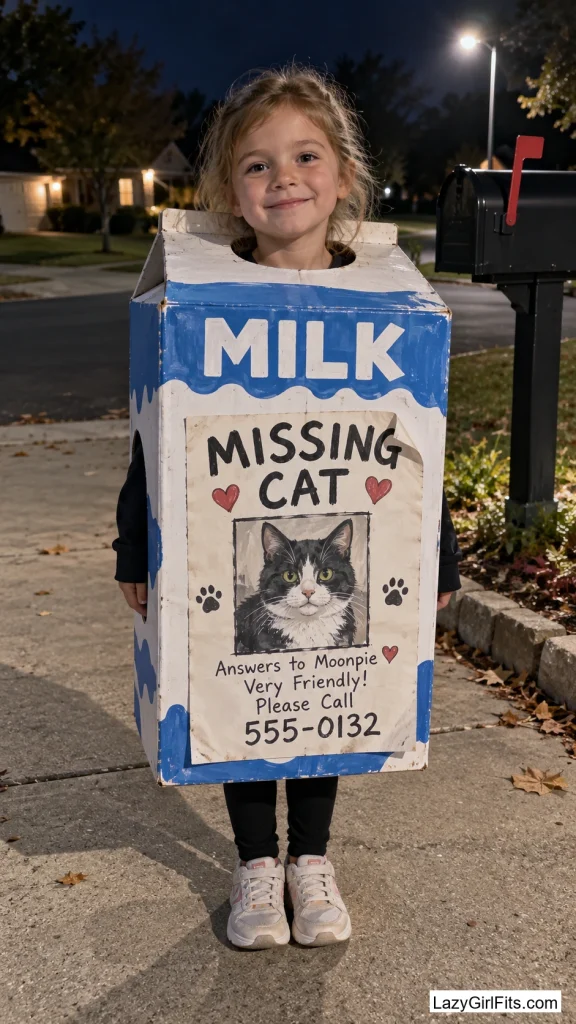
11. Missing-Cat Milk Carton
A half-gallon shape scaled up from a real milk carton — flat panel front and back, angled roof-shaped top — is worn like a sandwich board, with the classic carton graphics repainted or photocopied onto the front: brand name, expiration date, a glass of milk pouring. On the back panel, a black-and-white “missing” flyer with a cartoon cat, a joke phone number, and “last seen napping” does the actual joke.
This one lands because everyone recognizes the format before they’ve read a word of it — the layout of a missing-pet flyer is as familiar as a stop sign, so the gag reads instantly even to adults handing out candy in a hurry. Keeping the flyer text short, three or four lines at most, means it’s still readable at porch-light distance instead of needing someone to lean in and squint.
12. Box TV Stuck Between Channels
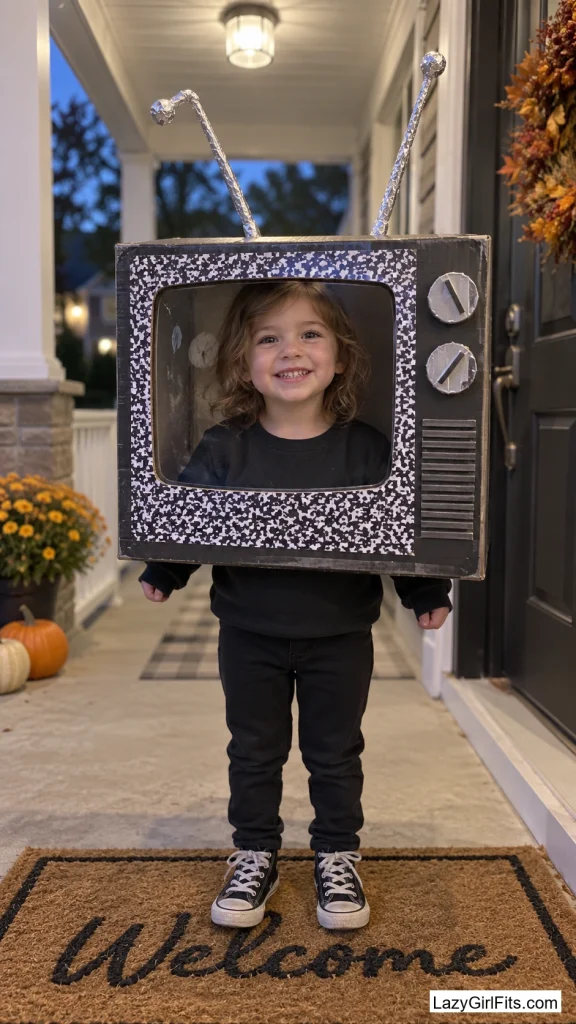
A roughly square box, the kind a small appliance or monitor ships in, gets a large rectangle cut from the front panel and backed with a sheet of gray or blue cellophane to suggest a glowing screen. Two circles of bottle cap or button glued to one side stand in for volume and channel knobs, and a short length of black cord with a plug shape cut from cardboard trails from the bottom corner.
Static, drawn as scattered black-and-white dots across a sheet of paper taped just behind the screen cutout, or a printed TV-static pattern found free online, is what makes this read as “between channels” instead of just “television.” A pair of foil-covered cardboard antennas taped to the top corners, bent slightly out of alignment, adds the finishing touch of a set that’s never quite tuned in right.
Games and Arcade Prizes
Anything shaped like a toy or a game already has a built-in visual joke — the trick is scaling it up to kid-size without losing the details that make it recognizable.
13. Jack-in-the-Box Mid-Pop
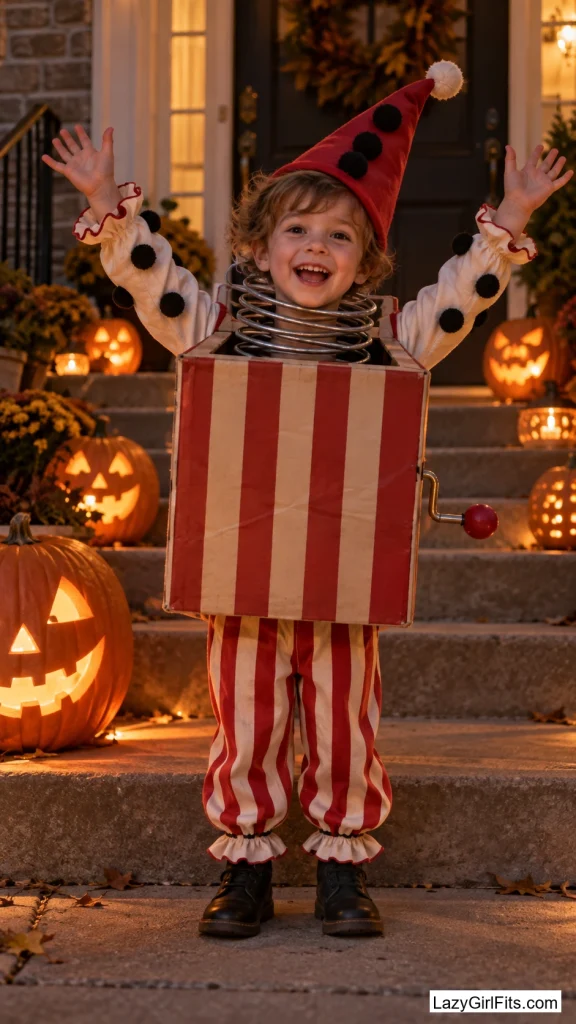
A cube-shaped box, sides painted in alternating stripes or a checkerboard pattern, is worn around the torso like a box with cutouts for the arms and legs, leaving the head free above the top edge. A crank shape, cut from cardboard and taped flat to one side, and a drawn tune title like “pop goes the…” on another side complete the box itself.
The “mid-pop” part comes from a coil of stiff wire or a slinky wrapped in fabric, worn around the neck like a collar so it sits between the box and the child’s head — from a few feet away it reads exactly like a puppet frozen halfway out of its box. A pointed felt hat in a bright color, the kind sold for jester costumes, finishes the look without needing any face paint.
14. Board Game Spinner
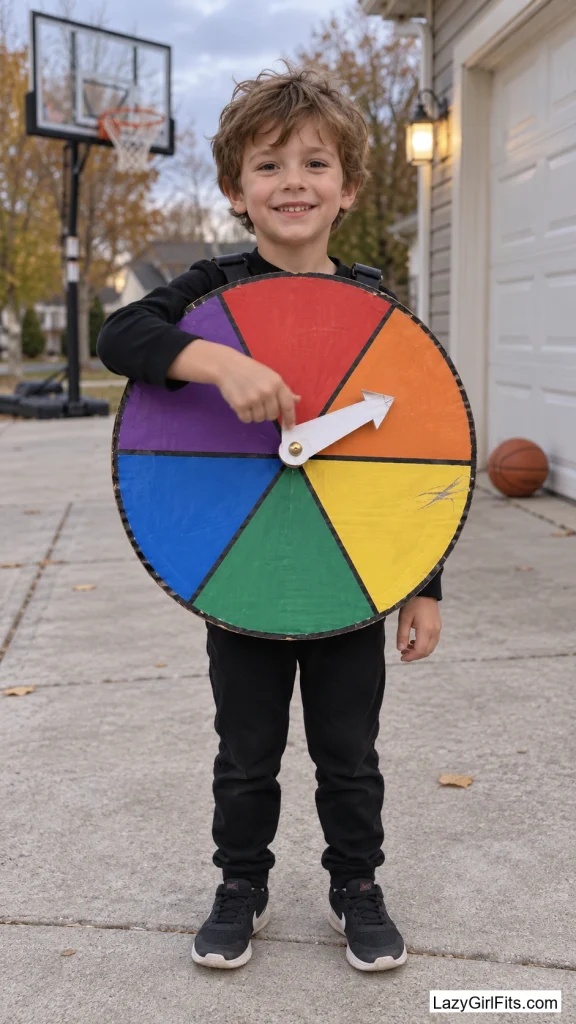
A large circle cut from a flattened box, divided into six or eight pie-slice wedges and painted in different bright colors, is worn flat against the chest like a sandwich-board front panel. A cardboard arrow, cut separately and attached at the center with a brass paper fastener, spins freely so it can point to whichever color a kid lands on when someone gives it a flick.
This works as a costume precisely because it invites a little interaction at the door — handing out candy while spinning a stranger’s costume is a small moment most trick-or-treat routines don’t otherwise have. Numbers or point values written around the outer edge, copied from an actual board game if there’s a favorite in the house, make the reference more specific without changing the build at all.
15. Claw Machine Prize
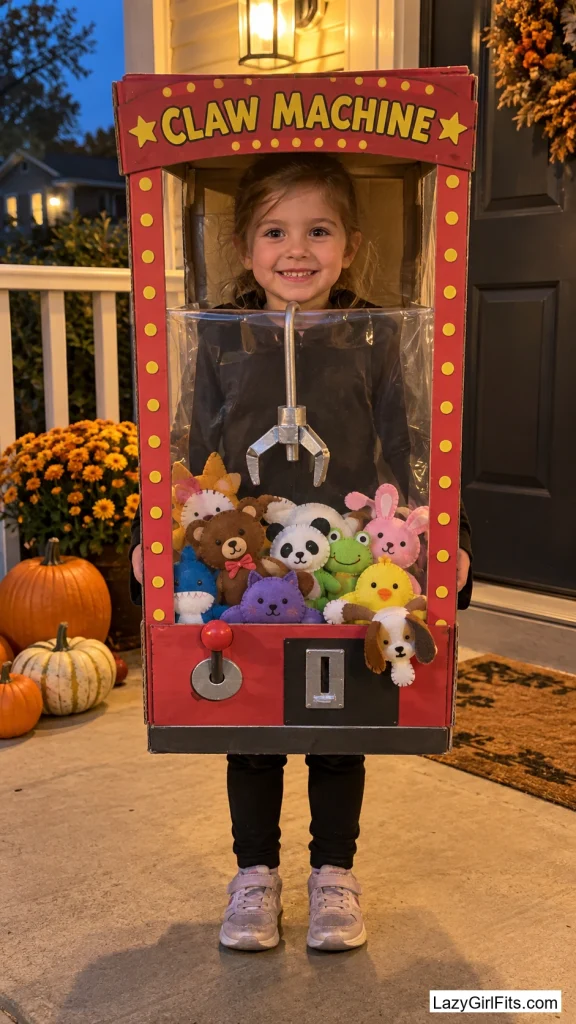
Rather than building the machine, this version puts the kid inside it as the prize. A tall box with the front panel replaced by a taped grid of clear packing tape strips, standing in for glass, becomes the case, worn like a sandwich board with the child’s head and shoulders visible above the top edge as if they’re the stuffed toy sitting on top of the pile.
A metal claw shape, cut from silver poster board and mounted on a rod or dowel so it appears to reach down from just above the child’s head, is the single detail that makes the joke land — without it, the costume just reads as a glass box. A pile of stuffed-animal shapes, cut from felt or fabric scraps and glued along the bottom edge of the front panel, fills out the “prize pile” the child is supposedly sitting in.
Because most of the structure is a flat front panel rather than a box wrapping all the way around, this stays light and lets a kid’s arms move freely to actually hold a treat bag. If a rod for the claw feels unwieldy for trick-or-treating, it can be shortened to a few inches and angled downward so it reads as reaching without sticking out far enough to catch on a doorframe.
Roadside and Sidewalk Objects
Street fixtures make surprisingly good costumes for kids because the real versions are already roughly kid-height and rectangular, which means very little resizing.
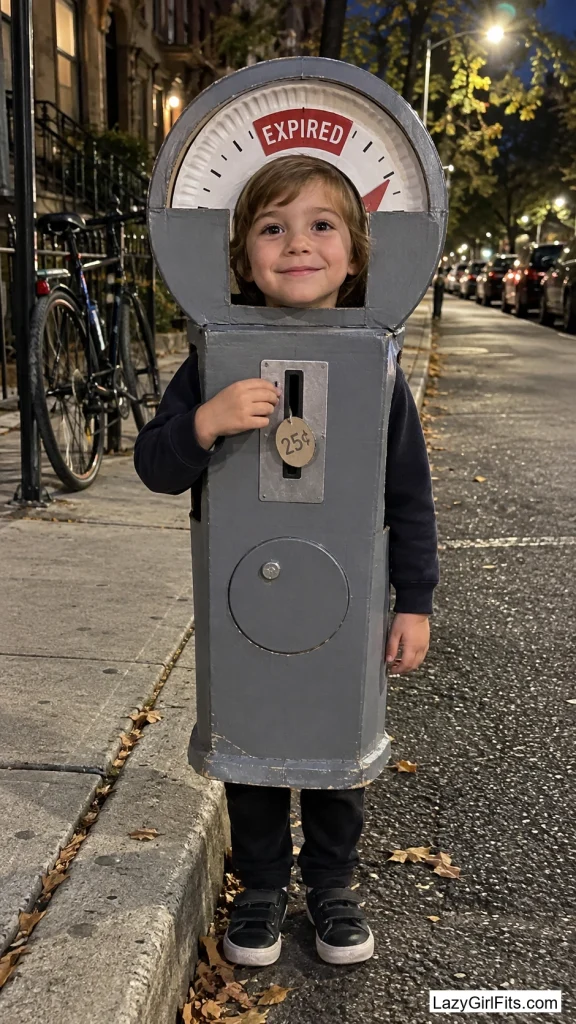
16. Parking Meter Stuck on Expired
A tall narrow box, the kind that ships a floor lamp or a rolled poster, is painted gray or silver and worn like a sandwich board that comes down to about knee height, leaving the legs free to walk normally. A circular dial near the top, drawn or cut from a paper plate and glued flat to the front, is where the display goes.
The word “EXPIRED” in red block letters across that circular dial is the entire joke, and it works because everyone who’s ever parked a car recognizes the shape and the panic that word causes. A slot cut just below the dial, with a few coin shapes cut from cardboard and glued mid-drop, suggests someone was just about to feed it and didn’t make it in time.
This costume’s narrow profile is genuinely useful for a kid weaving through a crowded sidewalk or a line at a house with a long porch — there’s no wide structure to bump into other trick-or-treaters. A short length of wrapping-paper tube glued to the bottom edge, meant to look like the meter’s pole, can be cut away entirely if it makes stairs harder to manage.
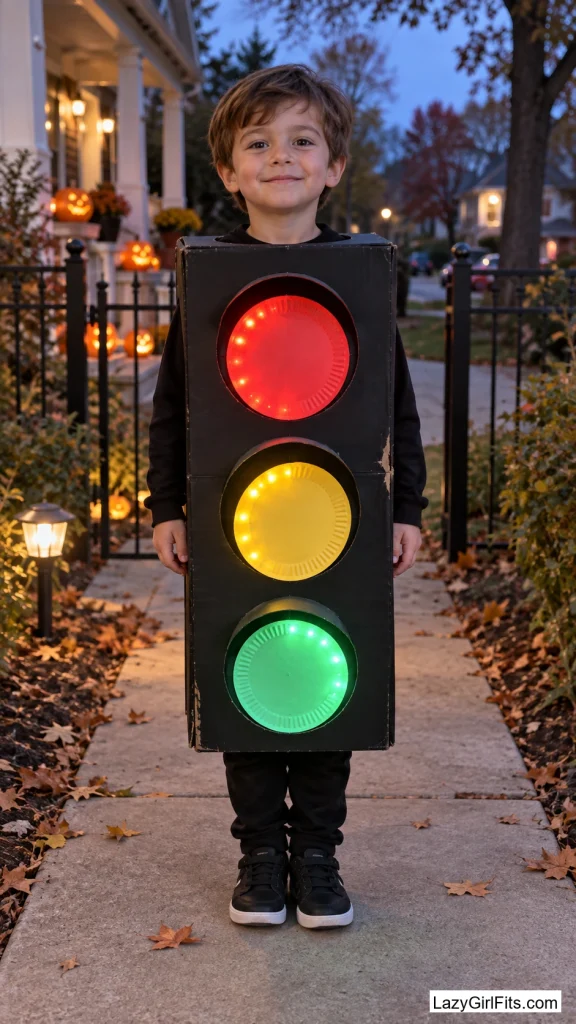
17. Traffic Light Cycling Colors
A tall rectangular box, the kind that ships two rolled rugs or a floor lamp, is the whole body, painted black or dark gray. Three circles, cut from paper plates and painted red, yellow, and green, are glued in a vertical row down the front, each with a ring of black construction paper behind it to look recessed rather than just painted on.
A battery-powered puck light or LED tea light taped behind whichever circle is “lit” lets a kid change which color is active over the course of the night, which turns a static costume into one with a small game built in. Heavy tape at the top corners, standing in for the mounting arm real traffic lights hang from, finishes the silhouette without adding real weight.
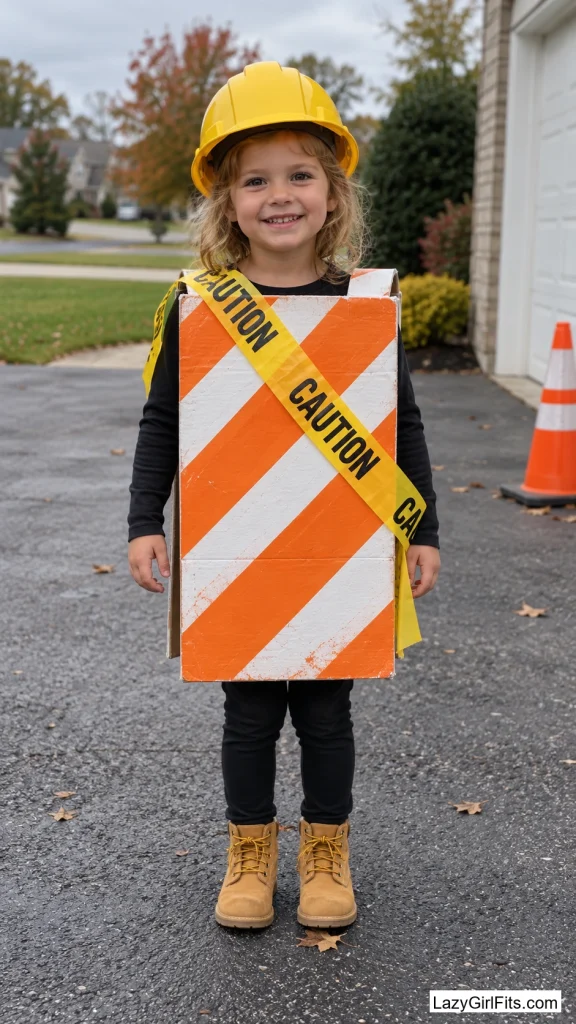
18. Under Construction Barricade
A wide, shallow box — a flattened case of water or paper towels works well — is painted white with two diagonal orange stripes across the front, the same pattern used on real roadwork barricades, and worn like a sandwich board that sits mostly below the waist. A real child-size hard hat, sold cheaply around Halloween at most costume stores, does more work than anything cardboard could replicate for the top half.
A length of actual caution tape, the yellow-and-black kind sold in hardware stores, tied loosely across one shoulder like a sash ties the barricade and the hard hat into one costume instead of two separate pieces worn together. A small printed sign reading “CANDY WORK ZONE” or “PARDON OUR MESS,” laminated or covered in packing tape so it survives a light drizzle, adds the joke.
Because the barricade panel is worn low and the hard hat does the height, this costume keeps a child’s face and vision completely unobstructed, which matters more on Halloween night than almost any other practical detail. If the caution tape feels flimsy after a few hours, a second strip added crosswise keeps the sash from sliding off a moving shoulder.
Party-Table Costumes
These borrow their look from the dessert table rather than the pantry, and the payoff is a costume that gets recognized the moment someone spots the shape from across a yard.
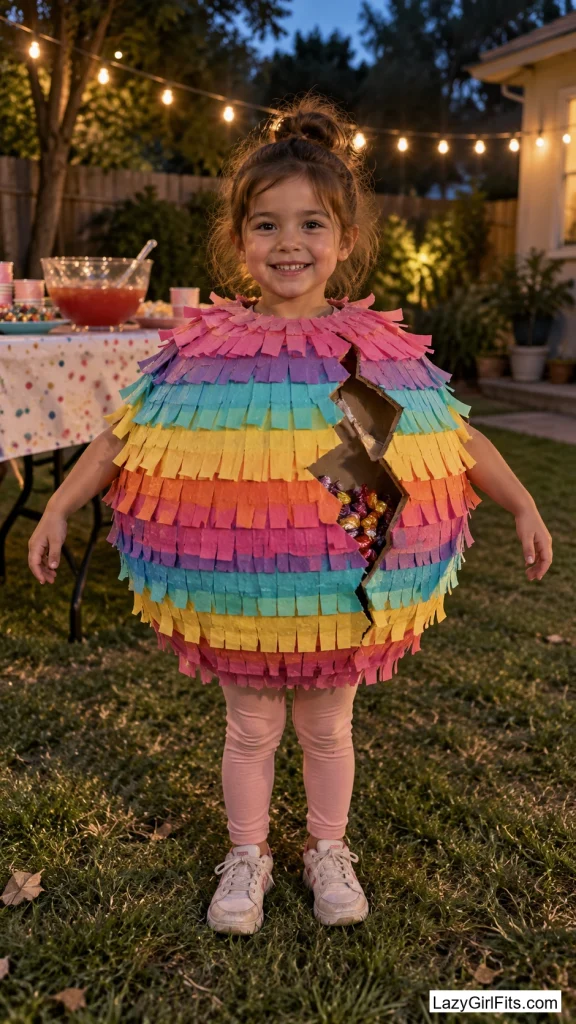
19. Already-Cracked Piñata
A round or star-shaped body, built from a large box or two round basins taped together, gets covered in overlapping strips of colored tissue paper fringe, glued in rows from the bottom up the way real piñatas are made. A single jagged crack, cut through one section of the shape before the fringe goes on, is left uncovered so a hint of the plain cardboard shows through underneath.
Wrapped candy, glued or tied just inside that crack so a few pieces appear to be spilling out without actually falling off during the night, sells the “already hit” idea better than the crack alone would. This costume works best worn like a poncho rather than a full wraparound shell, since the fringe adds visual bulk that doesn’t need to be doubled by a heavy structure underneath.
20. Fortune Cookie for Parents
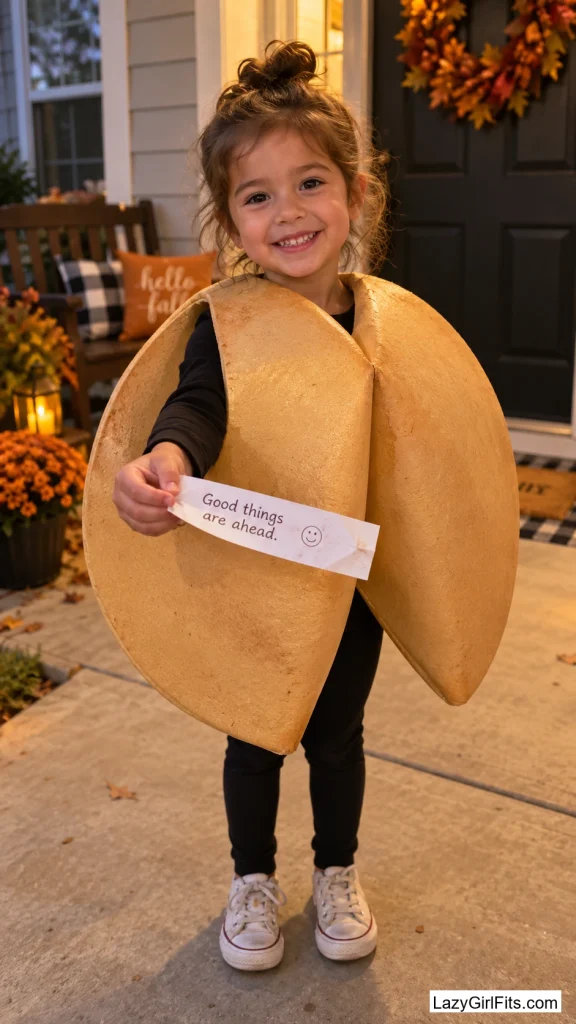
A single large fan-folded piece of cardboard, scored down the center and curved into the classic cookie crease, is worn like a rounded chest plate over the shoulders, painted a light golden tan with a slightly darker crease line down the middle. Getting the fold right takes a few practice bends on a spare scrap before committing to the final piece, since cardboard cracks if it’s folded too sharply in one motion.
A single paper strip printed with a fortune and tucked so it pokes out of the crease is where this one earns its name — something dry enough that parents handing out candy actually laugh, like “a long night of sorting candy awaits you” or “you will step on Lego before sunrise.” Kids don’t need to understand the joke for it to work; they just need to hand it over.
21. Vending Machine With a Stuck Snack
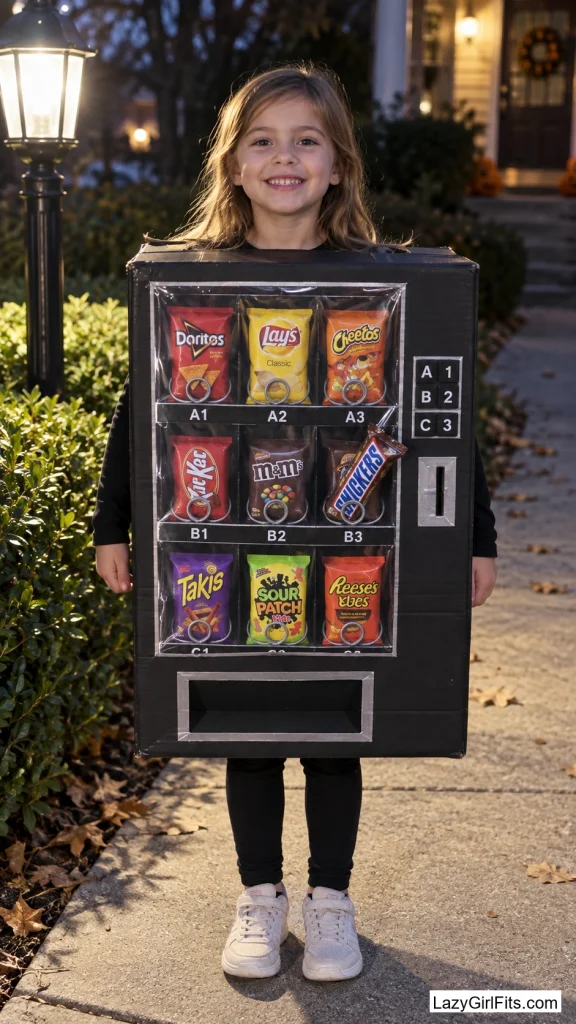
A tall box, the kind a floor lamp or a rolled rug ships in, worn like a sandwich board, gets a grid of small squares drawn or taped across the upper two-thirds to represent the snack rows, each with a printed candy wrapper or hand-drawn chip bag inside. A rectangle of cellophane or clear plastic wrap over that whole grid finishes the glass-front look.
One item, cut from cardboard or an actual empty wrapper, gets taped so it hangs half-fallen and crooked in its row, caught on the spiral coil the way real vending machine snacks get stuck. It’s a small, specific detail that makes the difference between “a box with candy drawn on it” and a machine a kid clearly built with a joke in mind, and it costs nothing beyond a piece of tape.
Final Thoughts
None of these need a trip to the craft store beyond paint, tape, and whatever’s already stacked by the recycling bin. Start with the box shape that’s already closest to what’s needed — flat and wide for a sandwich-board costume, tall and narrow for a machine, round for a wheel or a dial — and the rest of the build follows from there.
Cut armholes generously and test them with the child actually wearing the costume before gluing anything permanently. A costume that fits when you’re holding it up against their chest can still turn out too tight the moment they reach for a doorbell three hours into a night of trick-or-treating.